How do solar panels generate electricity?
How does a solar cell turn light into electricity?
A photovoltaic (PV) cell, or solar cell as it is usually called, converts sunlight directly into electricity without any moving parts. Sunlight is made of photons, which are packets of solar energy. The cell itself is built from a semiconductor.
When photons reach a PV cell, they can bounce off, pass straight through, or be taken in by the semiconductor. Only the ones that are taken in supply the energy for electricity. Once the semiconductor has absorbed enough sunlight, electrons are knocked loose from its atoms.
A special treatment applied to the surface during manufacture makes the front of the cell more welcoming to these free electrons. As the electrons drift towards the front, a difference in electrical charge builds up between the front and back of the cell. This difference produces a voltage, much like the negative and positive ends of a battery. Conductors on the cell gather the electrons, and when they are hooked up to an outside load such as a battery, current flows around the circuit.
From cell to panel to socket
A single PV cell makes just 1 or 2 watts, enough only for small things like a calculator or a wristwatch. Many cells are wired together inside a weatherproof PV panel. Panels can be grouped into an array, which may hold anything from two panels to hundreds.
PV cells produce direct current (DC). Almost all the electricity carried by transmission and distribution networks is alternating current (AC), so devices called inverters change the DC into AC.
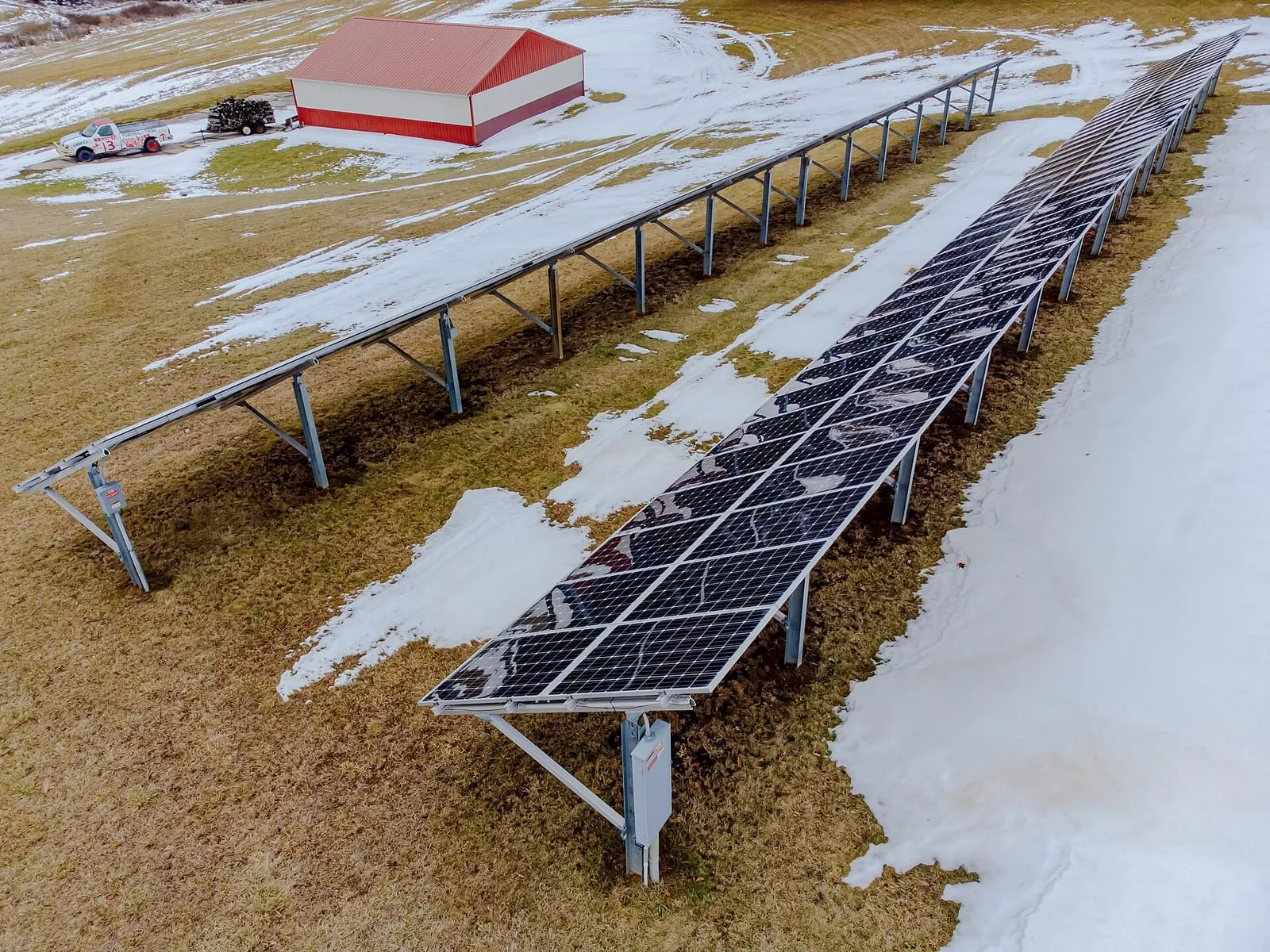
PV cells and panels give the most power when they face the Sun head-on. In most PV systems the panels stay in a fixed position and, in the northern hemisphere, usually point due south.
A PV system can bring electricity to places with no power lines. It can also charge a battery to cover the hours when the Sun is not shining. Arrays can be put up quickly.
What decides how efficient panels are?
The efficiency of commercial PV panels averaged below 10% in the mid-1980s, climbed to about 15% by 2015, and is now nearing 25% for the most advanced modules.
In a study published in 2013, panels in California that went 145 days through a summer drought without being cleaned or rained on lost only 7.4 percent of their efficiency. Dust that builds up on panels can cut output by as much as 30 percent in a single month. Cleaning panels takes about 10 billion gallons of water a year.
How did the idea of the solar panel begin?
A 19-year-old French scientist, Edmond Becquerel, discovered the photovoltaic effect in 1839. In 1883, Charles Fritts, an inventor from New York, made the first solar cell by covering selenium with a thin layer of gold. Fritts’s cell turned between 1 and 2 percent of the sunlight into electricity, whereas most modern solar cells work at 15 to 20 percent. It took Albert Einstein’s insight in 1905 to explain how these early cells worked.
In 1954, scientists at Bell Labs in the US stumbled on a breakthrough: silicon parts began producing an electric current when exposed to sunlight. A silicon solar cell with 6 percent efficiency was then built at Bell Labs. The American satellite Vanguard 1 became the first to use silicon solar cells, taking six solar panels into orbit in 1958. By 2016 the price of solar panels had dropped to 50 cents a watt, and it was still falling fast.
Test yourself
Three questions from the article. Pick an answer to find out.
Question 1 of 3
What happens in a photovoltaic cell when the semiconductor has absorbed enough sunlight?
Once the semiconductor has absorbed enough sunlight, electrons are knocked loose from its atoms. Source: eia.gov
Show answer
Right answer: Electrons are knocked loose from its atoms
Once the semiconductor has absorbed enough sunlight, electrons are knocked loose from its atoms. Source: eia.gov
Question 2 of 3
What do devices called inverters do in a PV system?
Devices called inverters change DC electricity into AC electricity. Source: eia.gov
Show answer
Right answer: They convert DC electricity into AC electricity
Devices called inverters change DC electricity into AC electricity. Source: eia.gov
Question 3 of 3
Who discovered the photovoltaic effect in 1839?
A 19-year-old French scientist, Edmond Becquerel, discovered the photovoltaic effect in 1839. Source: BBC
Show answer
Right answer: Edmond Becquerel
A 19-year-old French scientist, Edmond Becquerel, discovered the photovoltaic effect in 1839. Source: BBC