What is quantum? How does quantum physics work?
What does quantum mechanics explain?
Quantum mechanics is the branch of physics that shows how very small objects behave as particles and as waves at the same time. Physicists name this state “wave-particle duality”. The quantum realm looks nothing like the macroscopic world we see with our own eyes, which is run by what physicists call classical mechanics.
What does “quantum” mean?
The particle side has to do with objects being describable as “quanta”. A quantum is the smallest discrete unit of a natural phenomenon within a system whose units are in a bound state. The quantum of light is the photon.
A bound state is one in which particles are trapped; the electrons, neutrons and protons inside an atom are an example. To be “quantised” means that particles in a bound state can take only discrete values of properties such as energy or momentum. For example, an electron in an atom can have only certain very specific energy levels.
In our macroscopic world, by contrast, these properties can take any value within a range. A thrown baseball can have, essentially, any energy as it leaves the hand, flies through the air, slows down and comes to a stop.
What is a wave function?
Tiny quantised particles such as electrons can also be described as waves. Waves in the quantum world are constantly changing. Scientists speak of a particle’s “wave function”.
A wave function is a mathematical description of the probability that a particle is at a certain place, at a certain time, with a certain momentum.
Why did quantum mechanics emerge?
Quantum mechanics grew out of the great progress physicists made in the early 20th century in understanding the microscopic world. Before then, scientists believed that light was an electromagnetic wave and that electrons were distinct, point-like particles. This view caused problems when it came to explaining various phenomena in physics.
One of them is black-body radiation, the light that objects give off depending on their temperature. Quantum mechanics also helped in understanding the structure of the atom. It also helped make sense of the photoelectric effect, in which materials give off electrons when light of certain wavelengths strikes them.
By explaining that things can be both particles and waves, it solved these problems.
Where does quantum mechanics show up in everyday life?
Advances in lasers, light-emitting diodes, transistors, medical imaging and electron microscopes all grew out of quantum mechanics. Many subatomic particles, the proton among them, have an angular momentum called “spin”; medical experts make use of this property in MRI scanners. Billions of transistors sit inside every smartphone, and they work because of the wave nature of electrons.
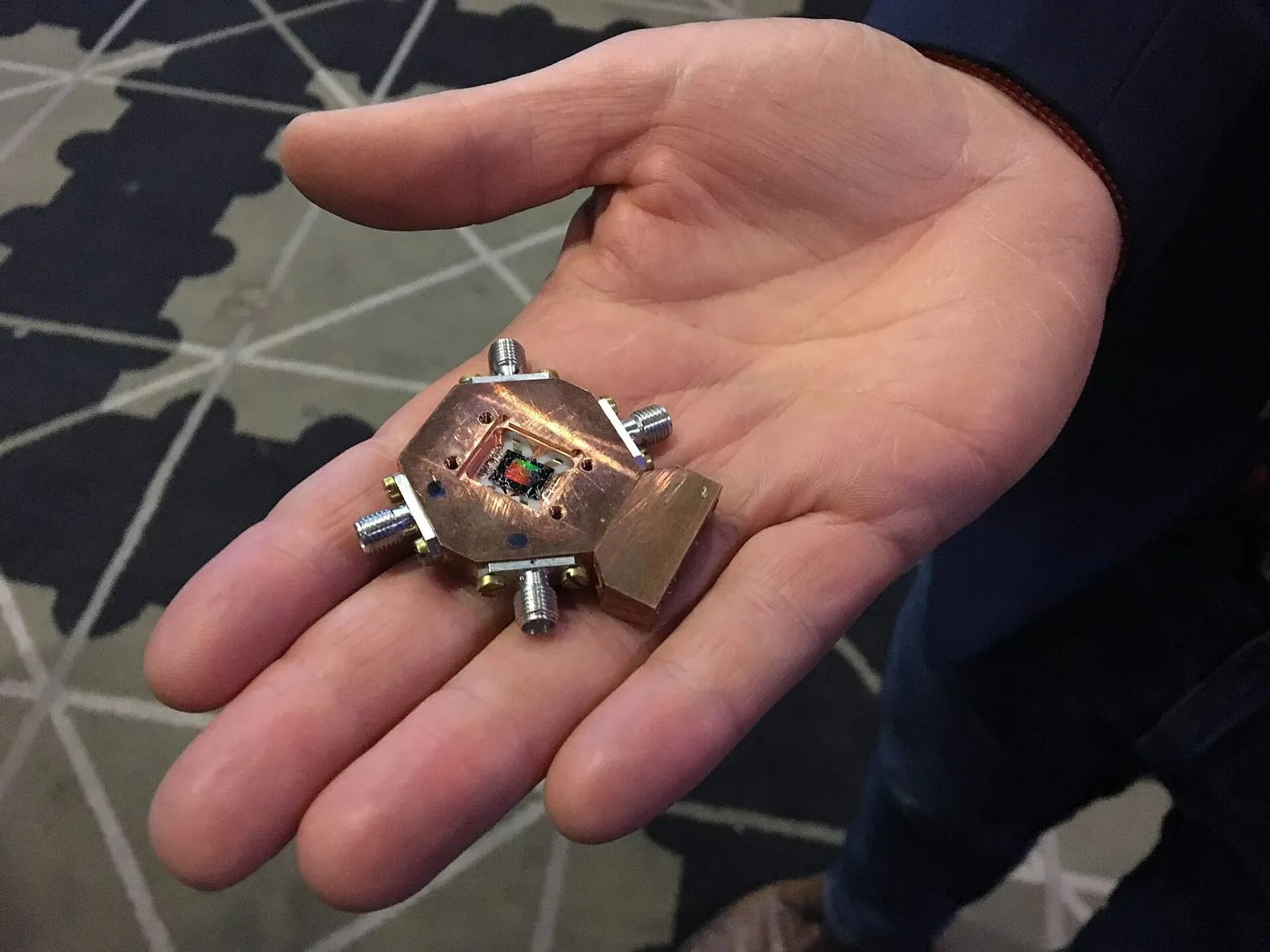
Among the newest uses are quantum computers and quantum networks, which exploit the quantised nature of particles to store and pass on information.
What is quantum entanglement?
Entanglement between quantum systems is a physical resource, like energy, linked to the unusual, non-classical correlations that can arise between systems that are apart. Two quantum systems in an entangled state can work as a channel for quantum information, carrying out computing and cryptography tasks that classical systems cannot do.
Test yourself
Three questions from the article. Pick an answer to find out.
Question 1 of 3
According to quantum mechanics, what properties do very small objects have?
Quantum mechanics explains that very small objects have both particle and wave properties at the same time. Source: Energy.gov
Show answer
Right answer: Both particle and wave properties at the same time
Quantum mechanics explains that very small objects have both particle and wave properties at the same time. Source: Energy.gov
Question 2 of 3
Which statement about an electron in an atom is true?
An electron in an atom can have only very specific energy levels. Source: Energy.gov
Show answer
Right answer: It can have only very specific energy levels.
An electron in an atom can have only very specific energy levels. Source: Energy.gov
Question 3 of 3
What is the quantum of light?
The quantum of light, that is, of electromagnetic radiation, is the photon. Source: Energy.gov
Show answer
Right answer: The photon
The quantum of light, that is, of electromagnetic radiation, is the photon. Source: Energy.gov