Why is Mars red?
Where does the Red Planet get its name?
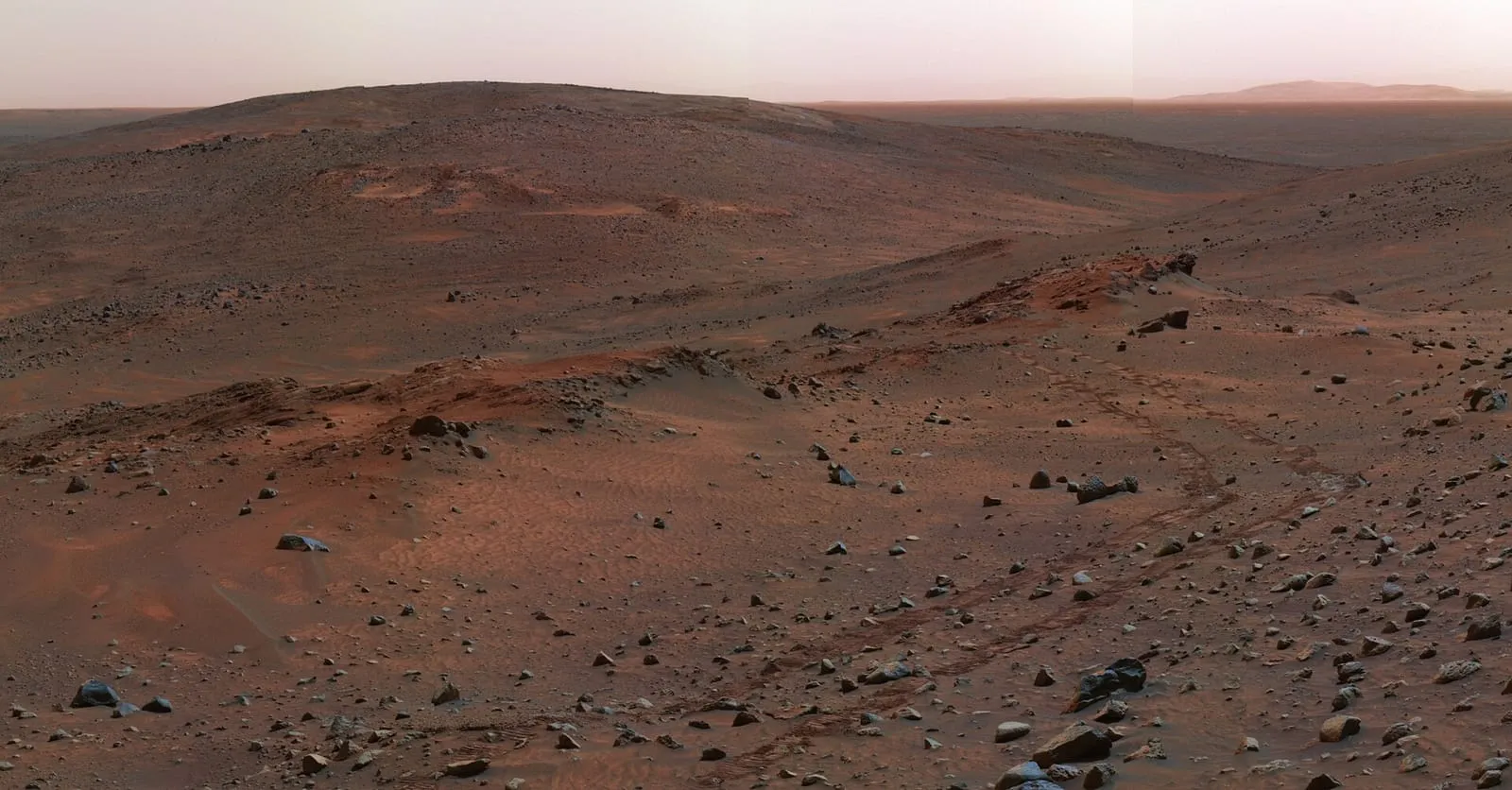
The ancient Romans named the planet after their god of war because its reddish colour reminded them of blood. Other civilisations also named the planet for this feature; the Egyptians, for example, called it “Her Desher”, meaning “the red one”. Mars is still often called the “Red Planet” today because the iron minerals in its soil oxidise, in other words, they rust. Adam Valantinas, lead author of a new study on the colour of Mars, points out that people have wondered why Mars is red for hundreds, perhaps thousands, of years.
Is Mars really red?
Mars actually has many colours; on the surface you can see shades of brown, gold and tan. Martian dust is known to be a mix of different minerals, including iron oxides. Because dust hangs in the air, the sky on Mars would look hazy and red rather than the familiar blue we see on Earth.
From time to time, winds on Mars become strong enough to whip up dust storms that cover much of the planet. After such storms, it can take months for all the dust to settle.
A new study: ferrihydrite
A study published in the journal Nature Communications suggests that ferrihydrite, one of the iron oxides in the dust, may be the reason for the planet’s colour. According to the study, ferrihydrite forms when cool water is present, and at lower temperatures than minerals such as hematite that had been considered before. The researchers say this suggests that, billions of years ago, before it turned into a dry world, Mars may have had an environment that could hold liquid water.
The researchers compared measurements from spacecraft orbiting Mars and rovers on its surface with laboratory experiments that tested how light interacts with ferrihydrite and other minerals. The artificial Martian dust made in the lab was a mixture of ferrihydrite and ground basalt, with particles smaller than one micrometre. The ochre colour of this dust is typical of iron-rich ferrihydrite. Valantinas says the team are not the first to consider ferrihydrite as the cause of Mars’s redness, but they can now test the idea better. Based on their analysis, the researchers think ferrihydrite is everywhere in the dust and probably in the rock formations too.
For ferrihydrite to form, there must be conditions in which oxygen, from the air or other sources, and water can react with iron. Such conditions were nothing like the dry, cold environment found on Mars today. The present-day atmosphere, by contrast, is too cold and thin for liquid water to last long on the surface. According to Valantinas, Martian winds spread this dust everywhere and created the planet’s familiar red appearance. Only when samples from Mars are brought back to Earth and studied will it be possible to test conclusively whether the team’s proposed formation model is right.
Why is Mars rustier than Earth?
The outer layers of Mars contain more than twice as much iron oxide as Earth’s outer layers. Yet most planetary scientists think the two planets formed from the same materials.
According to a study by David Rubie and colleagues at the University of Bayreuth, published in 2004, the intense heat inside the young Earth was high enough to turn much of its iron oxide into molten metallic iron. The researchers say Mars never reached these temperatures because it is smaller. As a result, more iron oxide stayed in the planet’s upper layers, and Mars gained its distinctive reddish-brown hue. By the team’s calculations, this process left only 8 percent iron oxide in Earth’s outer mantle. Their experiments predict a solid outer mantle with about 18 percent iron oxide for Mars, a figure that matches observations of Martian geology.
Test yourself
Three questions from the article. Pick an answer to find out.
Question 1 of 3
Why does Mars look red?
Mars looks red because the iron in its rocks, soil and dust has oxidised, in other words rusted. Source: NASA
Show answer
Right answer: Iron in its rocks, soil and dust has rusted
Mars looks red because the iron in its rocks, soil and dust has oxidised, in other words rusted. Source: NASA
Question 2 of 3
How much iron oxide do the outer layers of Mars hold compared with those of our own planet?
The outer layers of Mars hold more than twice as much iron oxide as those of our own planet. Source: Nature Publishing Group
Show answer
Right answer: More than twice as much
The outer layers of Mars hold more than twice as much iron oxide as those of our own planet. Source: Nature Publishing Group
Question 3 of 3
After a big dust storm on Mars, how long can it take for all the dust to settle?
After storms like these, it can take months for the dust to settle completely. Source: NASA
Show answer
Right answer: Months
After storms like these, it can take months for the dust to settle completely. Source: NASA