What are Saturn's rings made of?
What kind of planet is Saturn?
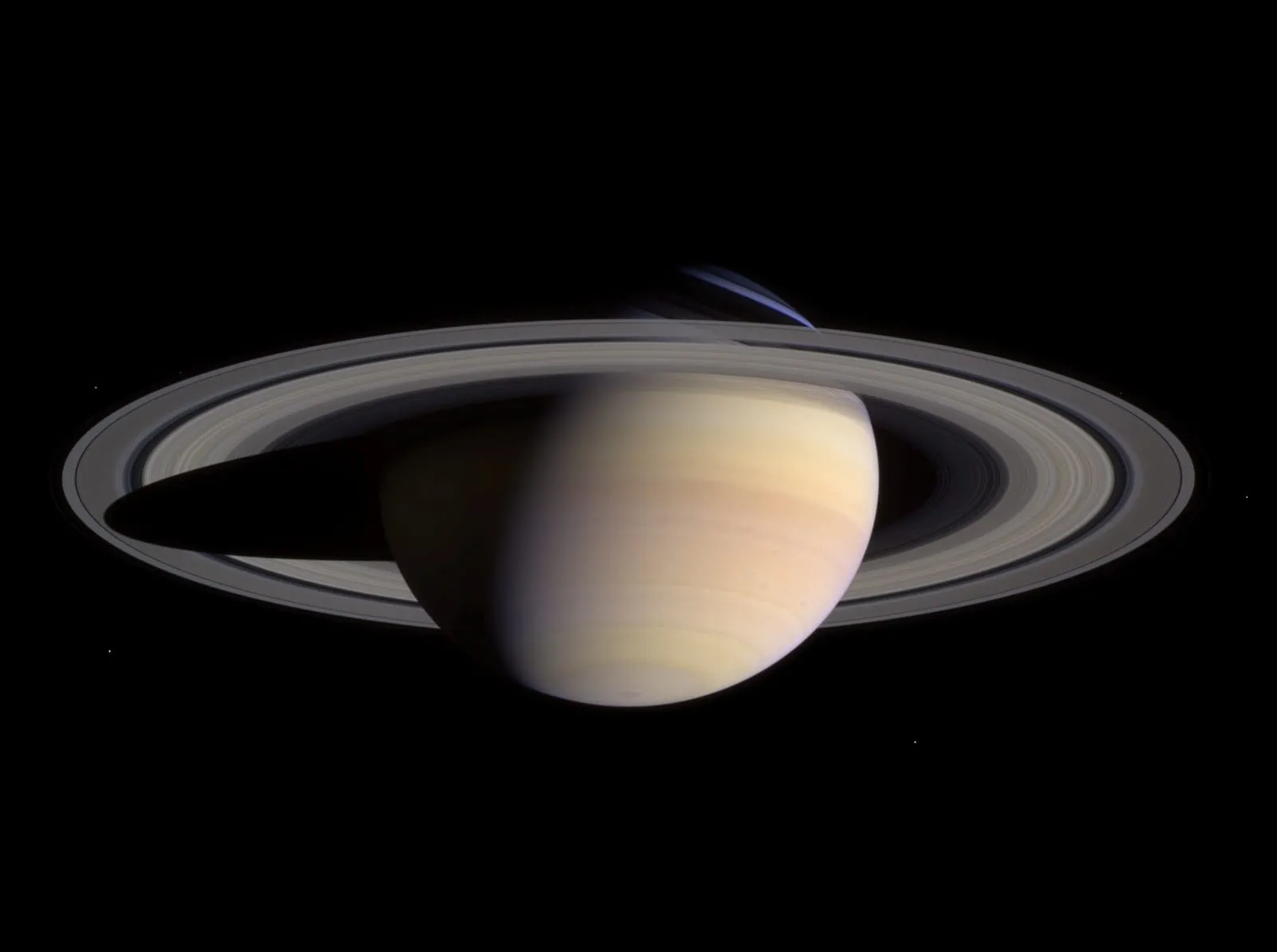
Saturn is the sixth planet out from the Sun, and the second biggest in the Solar System. It is not the only planet with rings, but no other planet’s rings are as magnificent or as complex as Saturn’s. On top of that, it has dozens of moons.
Saturn is the farthest planet from Earth that people discovered with the naked eye, and it has been known since ancient times. The planet is named after the Roman god of farming and wealth, who was also Jupiter’s father.
How big are the rings?
A few of the particles are as large as mountains. Seen from Saturn’s cloud tops, the rings would look mostly white. Each ring circles the planet at a different speed.
Saturn’s ring system reaches out as far as 282,000 kilometres from the planet, yet in the main rings the vertical thickness is typically only about 10 metres.
The names and gaps of the rings
The rings are named with letters in the order they were discovered. The main rings are A, B and C, while rings D, E, F and G are fainter and were found later.
A gap called the Cassini Division, 4700 kilometres wide, separates rings A and B. Much farther out, a very faint Phoebe ring lies in the orbit of Saturn’s moon Phoebe.
How were the rings studied?
Close flybys by Pioneer 11 and Voyagers 1 and 2, many years ago, threw new light on Saturn’s complex ring system. Cassini began the first in-depth, close-up study of Saturn and its rings and moons in 2004. It was the first spacecraft to go into orbit around Saturn. The Cassini spacecraft reached Saturn in 2004.
According to a 2005 news report, Cassini data show that Saturn’s ring system has an atmosphere of its own, separate from the planet’s. The same report says Cassini’s close passes found that the atmosphere around the rings is mainly molecular oxygen (O2).
Saturn itself
Saturn took shape about 4.5 billion years ago, along with the rest of the Solar System, when gravity pulled swirling gas and dust together into this gas giant. It is the only planet in the Solar System whose average density is lower than water. Saturn is a gas giant with no true surface.
Atmosphere and magnetic field
Winds in the upper atmosphere reach 500 metres per second in the equatorial region. At Saturn’s north pole there is a six-sided jet stream, and this hexagon pattern was first noticed in images from the twin Voyager spacecraft. The hexagon is about 30,000 kilometres across.
The magnetic field around Saturn is weaker than Jupiter’s, yet it is 578 times stronger than the one around Earth.
Test yourself
Three questions from the article. Pick an answer to find out.
Question 1 of 3
What are Saturn's rings made of?
The rings consist of billions of small pieces of ice and rock coated with materials such as dust. Source: NASA
Show answer
Right answer: Billions of small chunks of ice and rock
The rings consist of billions of small pieces of ice and rock coated with materials such as dust. Source: NASA
Question 2 of 3
Which rings does the Cassini Division separate?
The Cassini Division, 4700 kilometres wide, lies between rings A and B. Source: NASA
Show answer
Right answer: Rings A and B
The Cassini Division, 4700 kilometres wide, lies between rings A and B. Source: NASA
Question 3 of 3
Which are Saturn's main rings?
The main rings are A, B and C; D, E, F and G are fainter and were discovered later. Source: NASA
Show answer
Right answer: A, B and C
The main rings are A, B and C; D, E, F and G are fainter and were discovered later. Source: NASA