Rainbow colours: how does a rainbow form?
What does light do inside a water droplet?
A rainbow forms when sunlight is refracted and reflected by water droplets. A rainbow needs droplets hanging in the air, which is why we see one just after rain. A rainbow is an optical phenomenon seen when sunlight, atmospheric conditions and the viewer’s position are all right.
As sunlight enters a water droplet it bends a little (refraction), because light travels more slowly in water than in air. The light then reflects off the back of the droplet and returns the way it came, and it bends again as it leaves the droplet, speeding up.
Rainbow colours and their order
Sunlight is made up of many wavelengths, or colours, and some of these bend more than others as they enter a water drop. Violet, the shortest wavelength of visible light, bends the most, and red, the longest, bends the least. So by the time the light leaves the drop, it has been spread out into all its wavelengths. A rainbow is coloured because water drops act as tiny prisms: how much light bends on entering and leaving a drop depends on its colour.
The classic order of colours is red, orange, yellow, green, blue, indigo and violet; red has the longest wavelength and violet the shortest. In a rainbow, violet is at the bottom and red at the top. Isaac Newton popularised the idea of seven separate colours, but a rainbow is really a continuous spectrum containing far more shades than the eye can tell apart. Modern definitions mostly merge indigo into blue and violet.
Why is it an arc?
To see a rainbow, the Sun must be behind you and clouds must have moved away from in front of the Sun. With the Sun behind you, only the water droplets where the angle between you, the droplet and the Sun is about 42 degrees contribute to the rainbow. This angle is slightly different for red light and different again for blue light. You have to look at different places in the sky to see the red and blue arcs, which is why the colours appear as arcs of different sizes.
A rainbow is actually a full circle, but from the ground we see only part of it. From an aircraft, under the right conditions, the whole circle can be seen. With the Sun high in the sky, just a small arc may show above the horizon.
A rainbow is not an object that sits in a particular place in the sky. You cannot reach the end of a rainbow: wherever you stand, it is always formed by distant water droplets reflecting and bending sunlight. In fact everyone sees a different rainbow, because everyone has a different point directly opposite the Sun and a different horizon.
A second rainbow and other kinds
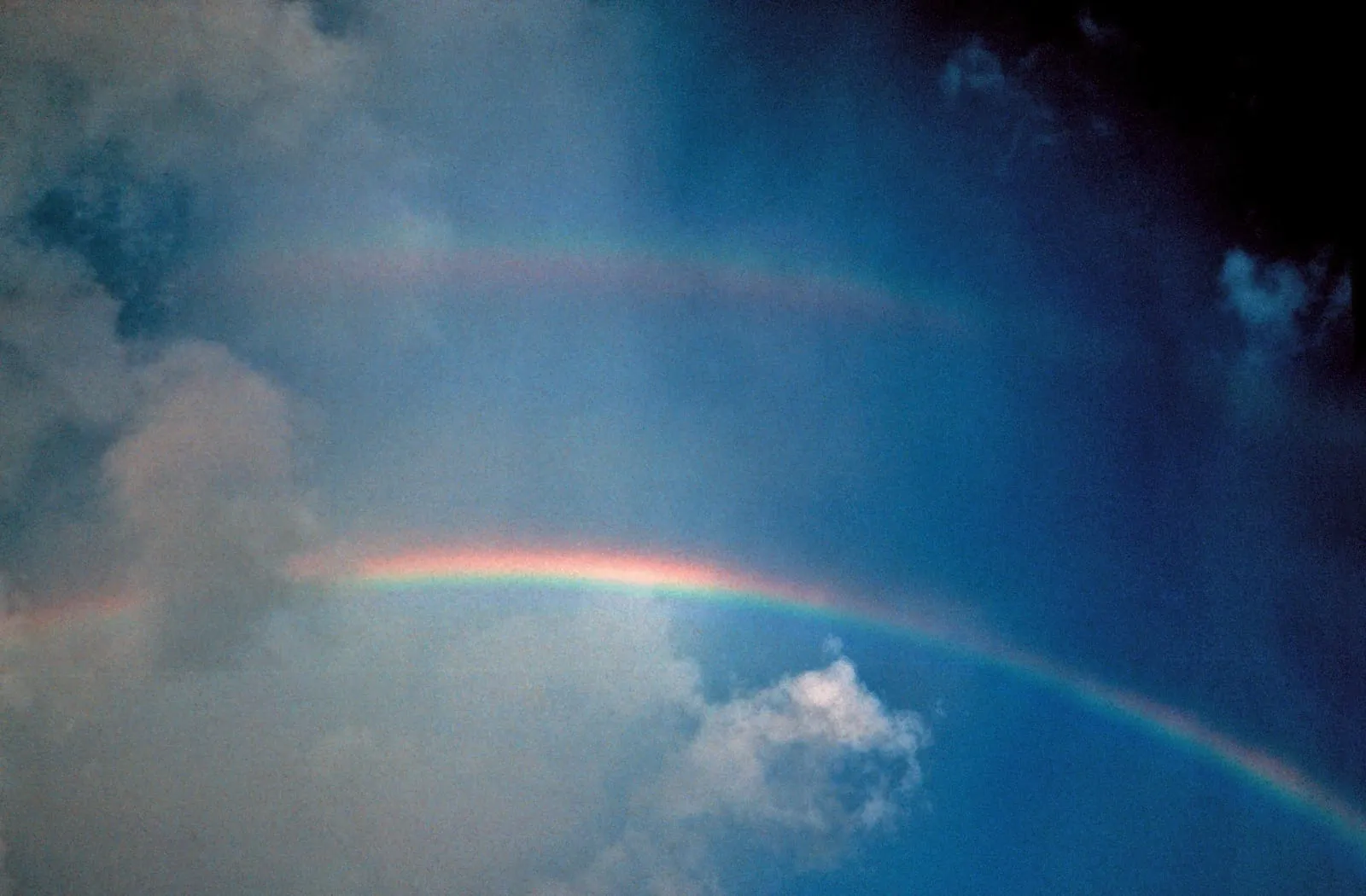
If light reflects twice inside the droplets, a second rainbow appears. The second rainbow is fainter and its colour order is reversed: red is at the bottom. In the second rainbow the light leaves the droplet at a different angle (50 degrees for red instead of 42 degrees), which is why the second rainbow appears above the first. The region between the two rainbows looks darker because no sunlight is scattered towards the observer there; it is called Alexander’s band.
In fog, mist or cloud fogbows, the water droplets are much smaller than raindrops; the light is diffused and the colours fade. This is why fogbows look pale or almost colourless and are wider than ordinary rainbows. Rainbows can also form at night, from moonlight instead of sunlight. These moonlight rainbows are rare, and because the light is too dim to trigger the colour-sensing cone cells, they usually look white to the naked eye.
Test yourself
Three questions from the article. Pick an answer to find out.
Question 1 of 3
When sunlight enters a water droplet, which colour bends the least?
Violet, the shortest wavelength of visible light, bends the most, and red, the longest, bends the least. Source: NOAA
Show answer
Right answer: Red
Violet, the shortest wavelength of visible light, bends the most, and red, the longest, bends the least. Source: NOAA
Question 2 of 3
How is the colour order in the second (double) rainbow compared with the first?
The second rainbow is fainter and its colour order is reversed: red is at the bottom. Source: NOAA
Show answer
Right answer: Reversed: red is at the bottom
The second rainbow is fainter and its colour order is reversed: red is at the bottom. Source: NOAA
Question 3 of 3
With the Sun behind you, water droplets at about what angle between you, the droplet and the Sun contribute to the rainbow?
With the Sun behind you, only the water droplets where the angle between you, the droplet and the Sun is about 42 degrees contribute to the rainbow. Source: University of Illinois Department of Physics
Show answer
Right answer: About 42 degrees
With the Sun behind you, only the water droplets where the angle between you, the droplet and the Sun is about 42 degrees contribute to the rainbow. Source: University of Illinois Department of Physics