How are stars formed?
What are stars?
Stars are giant balls of hot gas, made mostly of hydrogen with some helium and small amounts of other elements. The Milky Way holds more than 100 billion of them. Astronomers estimate that the universe may contain up to a septillion stars. Each star has its own life cycle, which can last anywhere from a few million years to trillions of years.
Molecular clouds
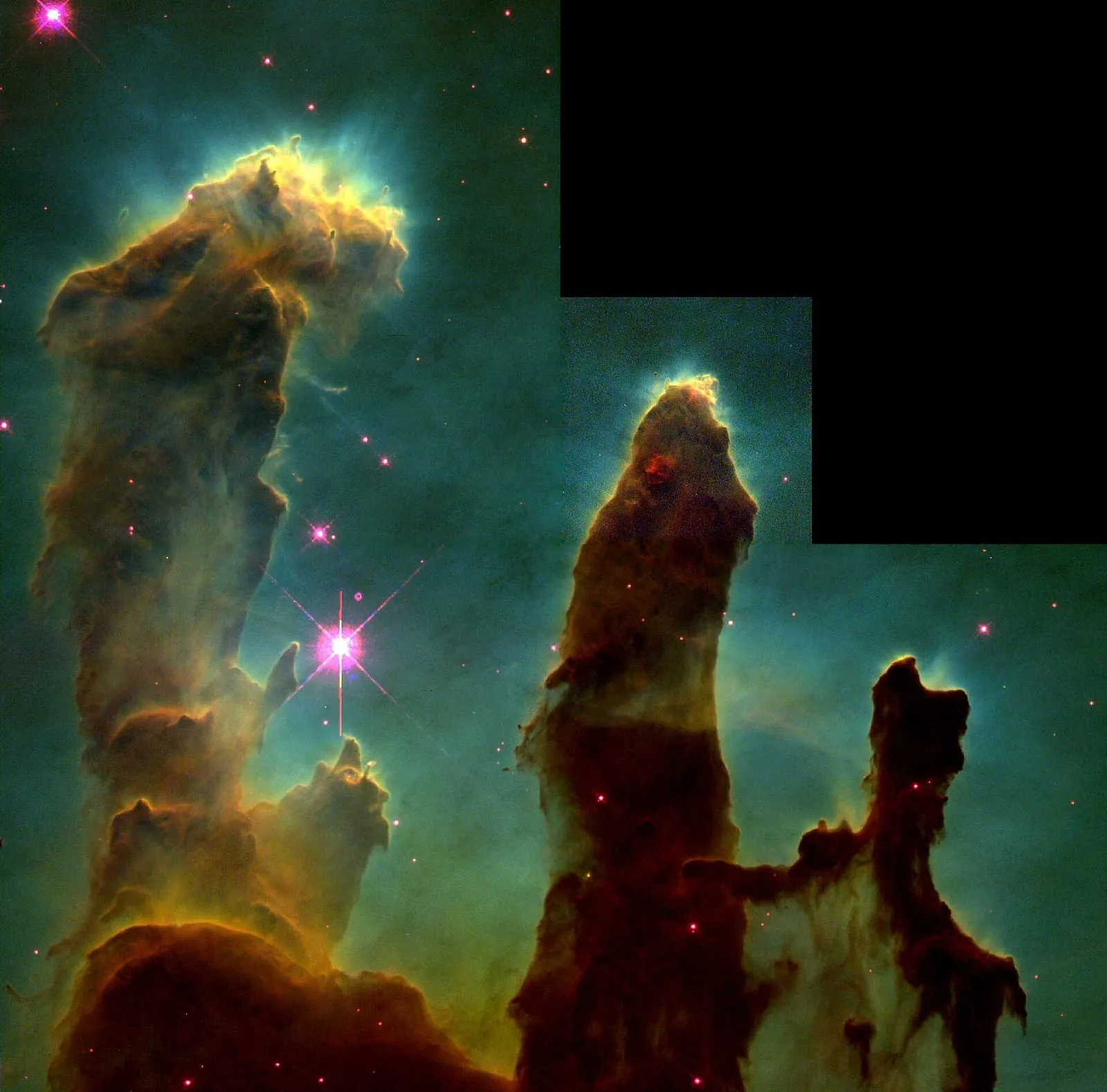
Molecular clouds range from 1000 to 10 million times the mass of the Sun, and they can stretch across hundreds of light-years. They are cold, which lets the gas gather into dense pockets. Some of these clumps may collide or pick up more material, and as their mass grows, so does their gravity.
Collapse and the protostar
Eventually, gravity makes some of these clumps collapse. At first, most of a protostar’s energy comes from the heat released in that initial collapse.
Groups of newly formed stars in molecular clouds are usually called star clusters. Molecular clouds full of star clusters are known as stellar nurseries. An ordinary star forms from a lump of dust and gas in a stellar nursery. The lump then spends hundreds of thousands of years gaining mass, starting to spin and warming up.
Fusion switches on
Once the lump’s core has heated to millions of degrees, nuclear fusion begins. Fusion releases energy, which warms the star and stops it from collapsing any further under gravity. Stars that steadily turn hydrogen into helium are called main sequence stars. This is the longest stage of a star’s life.
Main sequence stars make up about 90 percent of all the stars in the universe. The Sun is roughly in the middle of this stage. It is a 4.6-billion-year-old main sequence star, and scientists expect it to stay on the main sequence for about another 5 billion years before it becomes a red giant.
Mass sets a star’s lifespan
A star’s gas is its fuel, and its mass determines how fast that fuel gets used up: low-mass stars burn for longer than high-mass ones, and they are dimmer and cooler. High-mass stars have to burn fuel at a much higher rate to produce the energy that keeps them from collapsing under their own weight.
A few low-mass stars are expected to keep shining for trillions of years, a span longer than the universe’s age to date. Some high-mass stars will live for only a few million years.
Test yourself
Three questions from the article. Pick an answer to find out.
Question 1 of 3
Where do stars form?
Stars are born in large clouds of gas and dust known as molecular clouds. Source: NASA
Show answer
Right answer: In huge clouds of gas and dust called molecular clouds
Stars are born in large clouds of gas and dust known as molecular clouds. Source: NASA
Question 2 of 3
What process do the pressure and temperature in a protostar's core set off?
The pressure and temperature fuse hydrogen nuclei into helium, a process called nuclear fusion. Source: NASA
Show answer
Right answer: Hydrogen nuclei fusing to form helium
The pressure and temperature fuse hydrogen nuclei into helium, a process called nuclear fusion. Source: NASA
Question 3 of 3
Where is the Sun in its main sequence stage?
The Sun is about halfway through its main sequence life. Source: NASA
Show answer
Right answer: Roughly in the middle
The Sun is about halfway through its main sequence life. Source: NASA