How does rain form?
What is precipitation?
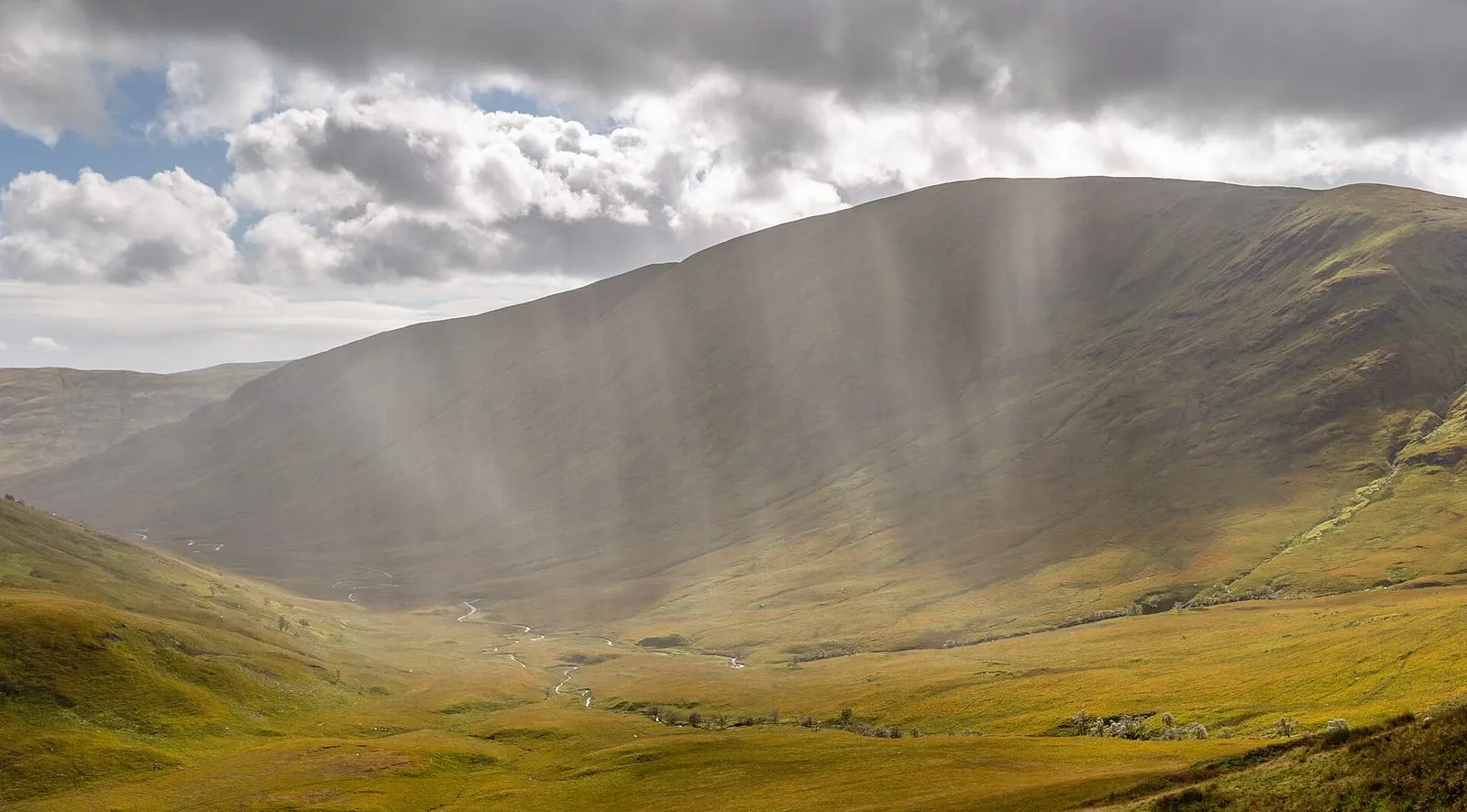
Precipitation is water that clouds let go of as rain, freezing rain, sleet, snow or hail. The bulk of it comes down as rain. It forms when the moisture in clouds grows too heavy to resist gravity and returns to the ground.
Why don’t cloud droplets fall straight away?
Clouds are made of water vapour and cloud droplets, which are tiny drops of condensed water. These droplets are too small to fall as precipitation, yet large enough to form a visible cloud. Most of the condensed water in clouds never falls, because its falling speed is not enough to overcome the rising currents of air that carry the cloud. Condensation alone does not cause precipitation.
How does air rise?
In convection, air is heated from below by sunshine or by contact with a warmer land or water surface, and becomes less dense than the air above it. The warmed parcel of air climbs until it has cooled back to the temperature of the air around it. As air rises it expands, and as it expands it cools.
How do droplets grow?
For precipitation to start, tiny water droplets must first condense on even smaller particles of dust, salt or smoke, which act as seeds. Without dusty air there would probably be no clouds at all, or only high-altitude ice clouds.
Water droplets can grow when particles collide and more water vapour condenses. One raindrop takes millions of cloud droplets. If enough collisions create a drop that falls faster than the cloud’s updraft, that drop leaves the cloud as precipitation.
Precipitation in cold and warm clouds
A more efficient way to make drops of precipitation size is a process in which ice crystals grow quickly at the expense of the water vapour in the cloud. The crystals can drop as snow, or they can melt on the way and arrive as rain. The process is called the Bergeron-Findeisen process.
In cold clouds, ice crystals and water droplets sit side by side. Because of an imbalance in water vapour pressure, the droplets move over to the ice crystals, and the crystals eventually grow heavy enough to fall to the ground.
In warm clouds, water droplets collide and exchange electric charge. Droplets with opposite charges attract one another and merge, growing until they are heavy enough to fall.
What does a raindrop look like?
Raindrops with a radius under 1 millimetre are spherical, like a round ball. When a drop is about 2-3 mm across, its underside becomes fairly flat and a dip forms in the middle, much like a hamburger bun.
When drops reach about 4-5 mm, the dip underneath widens so much that the drop takes on a parachute-like shape. The parachute shape does not last long, and the large drop breaks up into smaller ones.
Test yourself
Three questions from the article. Pick an answer to find out.
Question 1 of 3
How many cloud droplets does it take to make a single raindrop?
Cloud droplets are tiny, so a single raindrop takes millions of them. Source: USGS
Show answer
Right answer: Millions
Cloud droplets are tiny, so a single raindrop takes millions of them. Source: USGS
Question 2 of 3
Why does most of the condensed water in clouds not fall as precipitation?
The droplets fall too slowly to beat the rising currents of air that hold the cloud up. Source: USGS
Show answer
Right answer: Its falling speed is not enough to overcome the updrafts that carry the cloud
The droplets fall too slowly to beat the rising currents of air that hold the cloud up. Source: USGS
Question 3 of 3
What does the underside of a raindrop about 2-3 mm across look like?
At that size the underside of the drop flattens and a dip forms in the middle. Source: USGS
Show answer
Right answer: A flat base with a dip in the middle, like a hamburger bun
At that size the underside of the drop flattens and a dip forms in the middle. Source: USGS