How do black holes form?
What actually is a black hole?
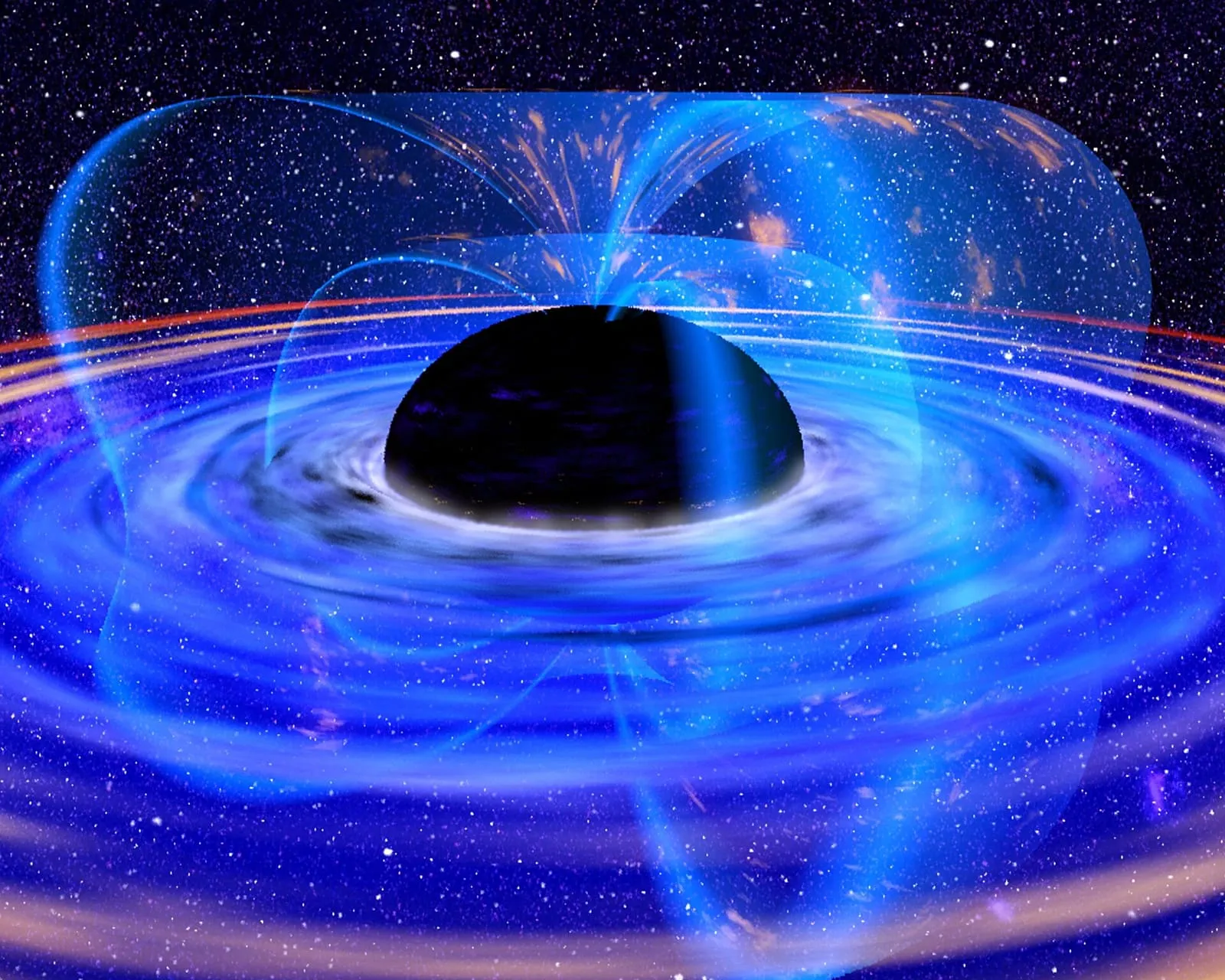
Black holes are not really holes. They are huge concentrations of matter packed into very tiny spaces. A black hole is packed so tightly that, just inside its surface, known as the event horizon, gravity is too strong for anything to escape, not even light. The event horizon is not a surface in the way that Earth or the Sun has one; it is a boundary enclosing all of the matter the black hole is made of.
The last days of a star
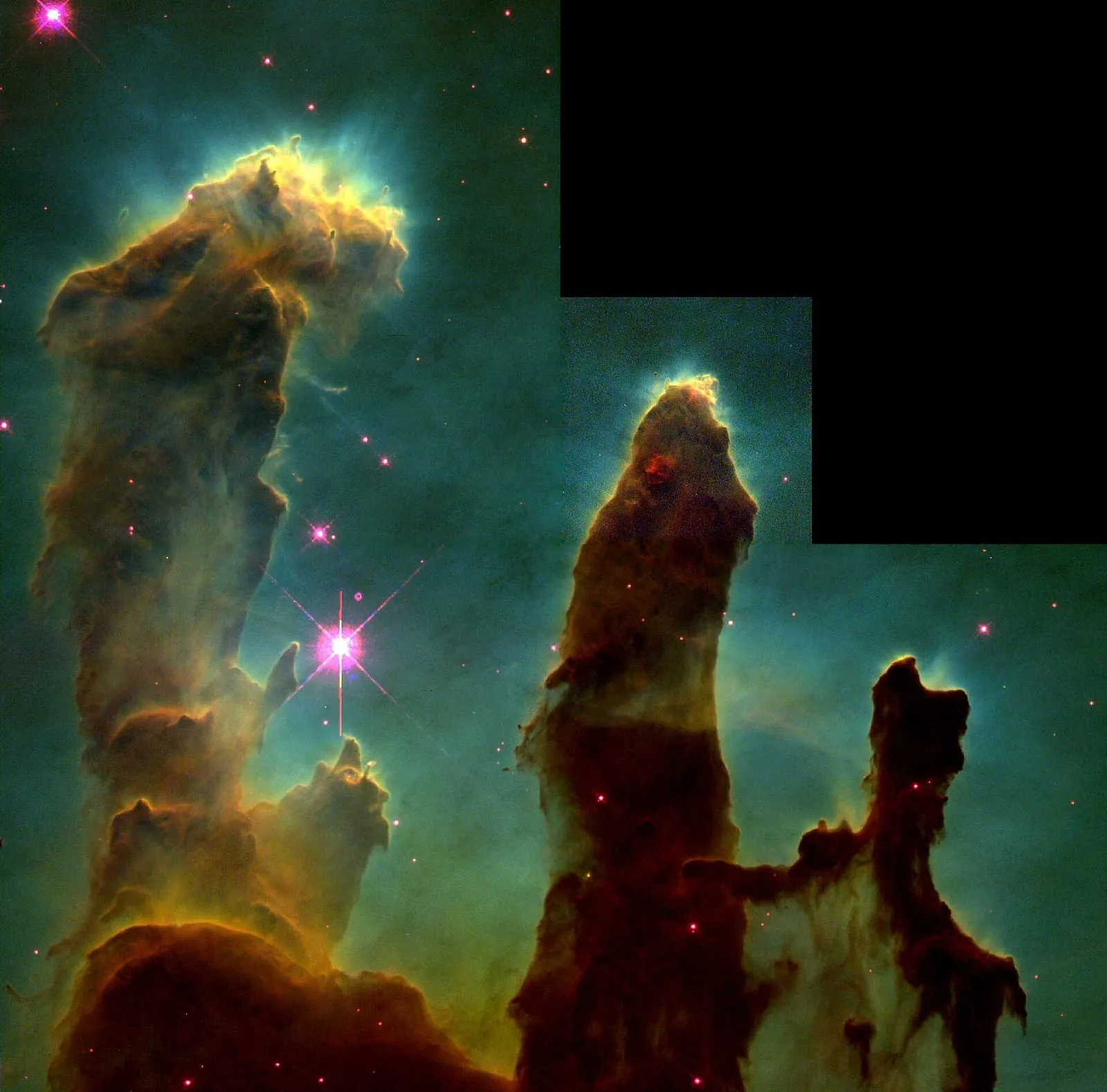
Some stars end their lives as black holes. The smallest black holes that form today are born when a massive star runs out of fuel. As nuclear fusion slows down, the star’s outward pressure weakens and the inward pull of gravity wins the tug of war. The star contracts and may become dense enough to turn into a black hole.
Once the energy holding the star together is gone, the star falls in on itself and an explosion follows. One kind of black hole forms when a massive star uses up its fuel and blows apart as a supernova.
But there is a lower limit for this: the star’s mass must be at least eight times that of the Sun. Lighter stars become either white dwarfs or neutron stars.
The singularity and the event horizon
All the material left over from the explosion, with many times the mass of the Sun, falls into an infinitely small point. The point where all this mass is trapped is called a singularity. A singularity may be infinitely small, but its influence is enormous.
Picture a circle with a singularity at its centre: inside that circle, gravity is so strong that nothing, not even light, can get out. That is why a black hole is black. This circle is called the event horizon.
If a spacecraft came close to the event horizon, gravity would be much stronger on the side nearer the black hole than on the other side, so the spacecraft would be stretched out like a strand of spaghetti. The technical term for this is spaghettification.
Other ways they form
Black holes can also form in other ways. Besides the collapse of stars, the merging of heavy objects is another way black holes form today.
Giant black holes
Large black holes can hold anywhere from tens to millions of times the mass of the Sun in a point smaller than the tip of a pin. Most galaxies the size of the Milky Way have giant black holes at their centres. The giant black hole at the centre of our galaxy has 4 million times the mass of the Sun.
They may have formed in the universe’s first moments
Scientists suspect that smaller “primordial” black holes, some with masses close to Earth’s mass, may have formed in the first chaotic moments of the early universe. Scientists think that as the universe was born, it went through a brief but intense phase called inflation, when space expanded faster than the speed of light. Under those unusual conditions, pockets that were denser than the space around them may have collapsed into low-mass primordial black holes. The event horizon of such a black hole with the mass of Earth would be about as wide as a US dime coin.
Stephen Hawking proposed that black holes can slowly shrink as radiation escapes. According to the theory, the smallest primordial black holes should have evaporated before the universe reached its current age, but those with masses close to Earth’s mass may have survived.
Do black holes swallow everything?
Black holes are not cosmic vacuum cleaners: they do not suck in other matter. Seen from a great enough distance, a black hole pulls on things just as any other object of equal mass would. Swap the Sun for a black hole with the same mass and the Solar System would become far colder, yet the planets would keep to their orbits.
Test yourself
Three questions from the article. Pick an answer to find out.
Question 1 of 3
At least how massive must a star be to collapse into a black hole?
For a star to collapse into a black hole, it needs at least eight times the mass of the Sun. Source: NASA
Show answer
Right answer: Eight times the mass of the Sun
For a star to collapse into a black hole, it needs at least eight times the mass of the Sun. Source: NASA
Question 2 of 3
How many times the Sun's mass is the giant black hole at the centre of our galaxy?
The giant black hole at the heart of our galaxy has 4 million times the mass of the Sun. Source: NASA
Show answer
Right answer: 4 million times
The giant black hole at the heart of our galaxy has 4 million times the mass of the Sun. Source: NASA
Question 3 of 3
Do black holes suck in the matter around them like a vacuum cleaner?
Black holes are not cosmic vacuum cleaners: they do not suck in other matter. Source: NASA
Show answer
Right answer: No, they do not suck in other matter
Black holes are not cosmic vacuum cleaners: they do not suck in other matter. Source: NASA