How do earthquakes happen?
Why does the ground shake?
One of the first people to explain the cause of earthquakes correctly was the British engineer John Michell, in 1760. According to Michell, earthquakes and the waves of energy they send out were caused by masses of rock shifting kilometres beneath the surface. It was not until 1855 that faults were recognised as the source of earthquakes.
The point underground where a fault starts to break is called the hypocentre of the earthquake. The point on the surface directly above it is called the epicentre. Most earthquakes happen at depths of less than 80 km.
How fast do the plates move?
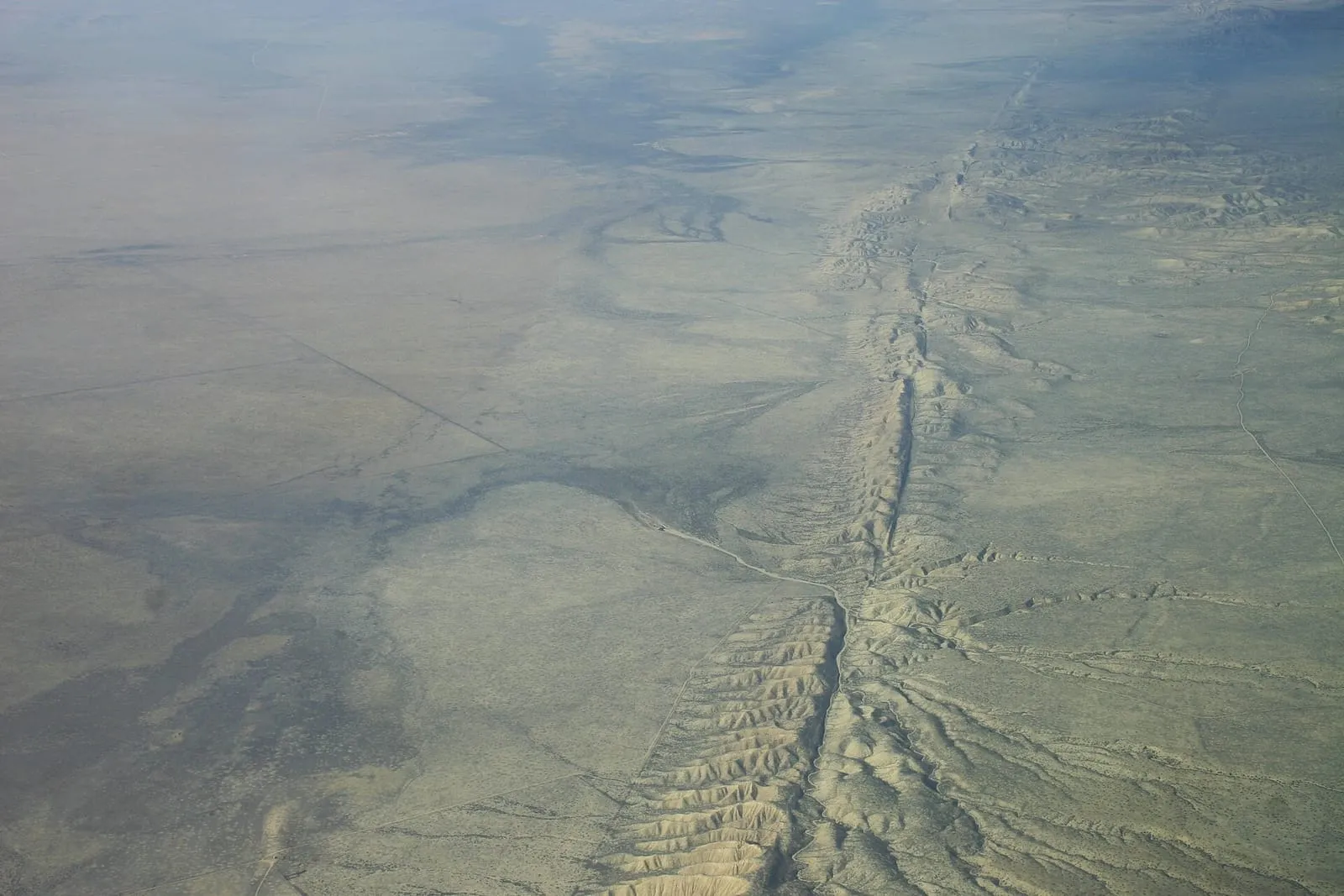
Along the San Andreas Fault Zone in the US, movement has averaged 56 mm a year over the past 3 million years. That is roughly the speed at which our fingernails grow. Nor is the San Andreas a single, continuous fault: it is a fault zone made up of many segments, and movement can happen on any of them.
When one plate dives beneath another, the process is called subduction: an oceanic plate collides with a continental plate and sinks beneath it. The deepest earthquakes usually happen at these boundaries, as deep as 750 km below the surface. Plates can also pull apart: the East African Rift System is a rare example of a continental plate trying to split in two.
Where do most earthquakes happen?
Most earthquakes and volcanic eruptions occur along plate boundaries. The Ring of Fire around the Pacific Ocean is home to about 90% of the world’s earthquakes. The second most active region, with 5–6% of earthquakes, is the Alpide belt, which stretches east from the Mediterranean through Turkey, Iran and northern India.
It is estimated that around 500,000 detectable earthquakes happen around the world every year. About 100,000 of these can be felt, and only 100 cause damage. Contrary to a common belief, there is no known “earthquake weather”: statistically, earthquakes are spread equally across cold, hot and rainy weather.
How is stress passed along a fault?
In the view of Dr Ross Stein, when an earthquake happens, part of the stress built up along the fault is passed on along the fault line. Stein arrived at this idea in 1992, when a second earthquake struck 67 km away, 3 hours after the Landers earthquake in California.
Professor Geoffrey King, meanwhile, studied the cyclical behaviour of the North Anatolian Fault in northern Turkey. To do so, he used the model that had shown the link between the Landers and Big Bear earthquakes. Across the region, the earthquakes had travelled westwards from the east, and each cycle ended with a quiet spell. The first earthquake he looked at was the 1939 Erzincan earthquake; Tokat, further west, was struck in 1942, and Adapazarı in 1967. Because these earthquakes were years rather than hours apart, they were not counted as aftershocks. In August 1999, a very powerful earthquake lasting just 45 seconds struck İzmit, and many people lost their lives.
How does the shaking reach us?
The fastest wave an earthquake sends out is the P wave, so it is the first to arrive anywhere. The P wave alternately compresses and expands material in the direction it travels. Most earthquake waves have a frequency below 20 Hz, so the waves themselves usually cannot be heard. Most of the rumbling heard during an earthquake comes from buildings and their contents moving.
Earthquake waves have also revealed the inside of the Earth: in 1906, R. D. Oldham discovered the Earth’s core from earthquake records. Because the outer core is liquid, it does not transmit the energy of the shear waves released by an earthquake.
Are magnitude and intensity the same thing?
Magnitude is a measured value of an earthquake’s size, and it is the same wherever you are. Intensity, on the other hand, is a measure of the shaking an earthquake causes, and it varies from place to place.
The Richter scale was introduced in 1935 and is based on the amplitude of the waves recorded by a seismograph. On this scale, when the magnitude increases by 1, the amplitude of the shaking recorded at the same distance increases 10 times. Hiroo Kanamori developed the moment magnitude method in 1977 at the California Institute of Technology. Today, moment magnitude is the most widely recommended scale in the world. Other scales can saturate with very large earthquakes, meaning they stop rising beyond a certain point and can make an earthquake look smaller than it was. The largest earthquake ever recorded was a magnitude 9.5 earthquake in Chile in May 1960.
Can scientists know about an earthquake in advance?
It is not possible to say exactly when an earthquake will happen. According to a 2003 report by the US National Research Council, the stress at deep earthquake sources cannot be measured directly and can only be inferred from models. According to King, buildings can be improved and construction methods can be changed.
Test yourself
Three questions from the article. Pick an answer to find out.
Question 1 of 3
Roughly what share of the world's earthquakes happen in the Ring of Fire around the Pacific Ocean?
The Ring of Fire, which circles the Pacific Ocean, is home to about 90% of the world's earthquakes. Source: USGS
Show answer
Right answer: About 90%
The Ring of Fire, which circles the Pacific Ocean, is home to about 90% of the world's earthquakes. Source: USGS
Question 2 of 3
What was the magnitude of the largest earthquake ever recorded?
The largest earthquake on record struck Chile in May 1960 with a magnitude of 9.5. Source: USGS
Show answer
Right answer: 9.5
The largest earthquake on record struck Chile in May 1960 with a magnitude of 9.5. Source: USGS
Question 3 of 3
Does an earthquake's magnitude depend on where you are?
Magnitude is a measured value of an earthquake's size, and it is the same wherever you are. Source: USGS
Show answer
Right answer: No, it is the same wherever you are
Magnitude is a measured value of an earthquake's size, and it is the same wherever you are. Source: USGS