How does a tornado form?
What is a tornado?
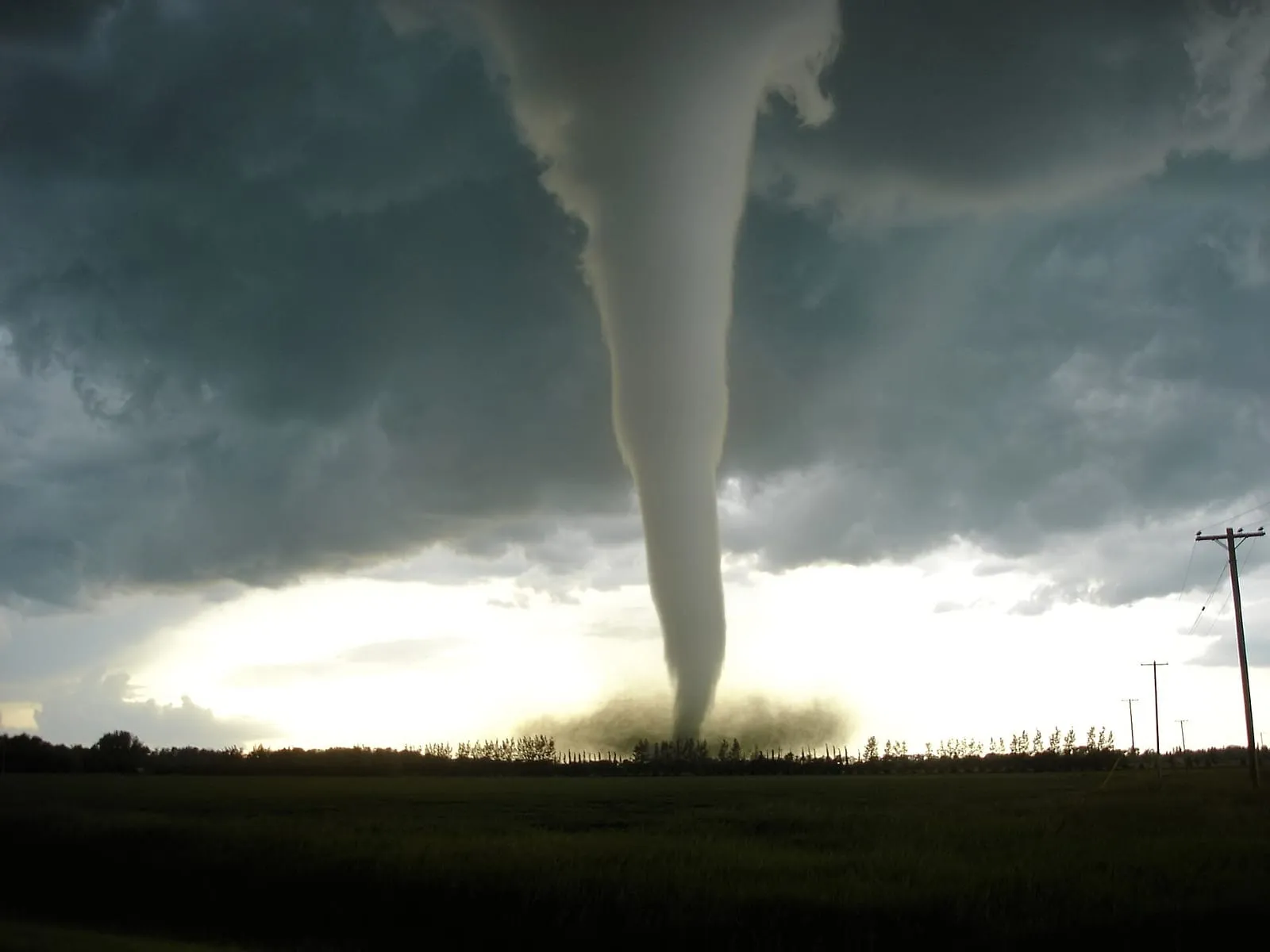
A tornado is a column of air that spins violently, hangs down from a cumulus-type cloud and touches the ground. A tornado turns visible once water vapour condenses into cloud and/or once it picks up dust and debris.
A funnel cloud is a visibly rotating column of air that reaches down from the base of a storm towards the ground without touching it. Once the funnel touches the ground, it is a tornado.
The conditions a storm needs
Storms intense enough to spawn tornadoes need many atmospheric conditions to be present at the same time. These include plenty of moisture near the surface and atmospheric instability. In the central US, the Gulf of Mexico is the source of much of that moisture.
Thunderstorms form when the atmosphere is unstable. Instability usually comes from differences in both moisture and temperature between a parcel of air and the atmosphere around it. Cold fronts are a good way to get air rising: the cooler, denser air clings to the ground and slides beneath the layer of warm air ahead of it, pushing that air upward.
How does the rotation start?
Wind shear, meaning a change in wind direction and/or speed with height, is a key ingredient in the formation of the severe thunderstorms that produce tornadoes. Vertical shear in wind speed creates a “rolling” effect in the atmosphere. When a storm forms under such conditions, that rolling motion makes the storm rotate once the storm’s rising air tilts it upward.
The combination of strong speed shear and strong directional shear generally favours supercells, which are defined by a deep, persistently rotating updraft. Supercells are the storm type that most often produces tornado activity. Strong and violent tornadoes are expected mostly with supercell thunderstorms, although tornadoes can also appear in bow-shaped lines of storms.
Why doesn’t every storm produce a tornado?
The notion that tornadoes form when warm, moist air meets cold Canadian air and dry air from the Rocky Mountains is a gross oversimplification. Plenty of thunderstorms that form under those conditions never come anywhere near producing a tornado. Even when the large-scale setting is quite favourable for tornadoes, not every storm produces one.
Tornadoes form through complicated processes that operate on the scale of the storm. Newer theories suggest that the temperature and moisture of the supercell’s rear-flank downdraft are very important in producing a tornado.
Where do they occur?
A tornado can strike anywhere in the US, yet they are most frequent across the central plains lying between the Rocky Mountains to the west and the Appalachians to the east. Elsewhere, they can arise in numerous regions around the globe, among them Australia, Europe, Africa, Asia and South America.
Test yourself
Three questions from the article. Pick an answer to find out.
Question 1 of 3
When does a rotating column of air that reaches down from the base of a storm become a tornado?
A rotating column that has not reached the ground is called a funnel cloud; once it touches the ground it is a tornado. Source: MRCC
Show answer
Right answer: When it touches the ground
A rotating column that has not reached the ground is called a funnel cloud; once it touches the ground it is a tornado. Source: MRCC
Question 2 of 3
Which type of storm most often produces tornadoes?
Supercells are the most common type of storm to produce tornado activity. Source: MRCC
Show answer
Right answer: The supercell
Supercells are the most common type of storm to produce tornado activity. Source: MRCC
Question 3 of 3
What happens when the large-scale environment is very favourable for tornadoes?
Even when conditions are favourable, not every storm gives rise to a tornado. Source: weather.gov
Show answer
Right answer: Even so, not every storm produces a tornado
Even when conditions are favourable, not every storm gives rise to a tornado. Source: weather.gov