How do lightning and thunder form?
What are lightning and thunder?
Lightning is a giant electrical spark that forms in the atmosphere or between the atmosphere and the ground. Thunder is the sound a lightning strike makes.
Watching lightning can be fascinating, but it is extremely dangerous. About 25 million lightning flashes strike the US every year. Although lightning deaths have fallen over the last 30 years, lightning remains one of the deadliest weather hazards in the US.
How does a thunderstorm develop?
Every thunderstorm goes through stages of growth, development, electrification and dissipation. Thunderstorms frequently start building in the early part of the day, once the Sun has warmed the air close to the ground and pockets of warmer air begin to climb through the atmosphere.
Once these air pockets have climbed to a certain height, cumulus clouds begin to take shape. As the heating continues, these clouds grow upward. Towering cumulus clouds like these can be among the first signs of a developing thunderstorm. In the final stage of development, the top of the cloud takes on an anvil shape.
How does electric charge build up inside the cloud?
As a storm cloud grows, precipitation forms inside it. The upper levels of a well-developed storm cloud mostly hold small ice crystals. In the middle levels there is a blend of tiny ice crystals and small hail. The lower levels hold a mixture of rain and melting hail.
Air movements in the middle of the cloud and collisions between different types of precipitation give the precipitation particles an electric charge. Lighter ice crystals pick up a positive charge, and the updraft lifts them to the top of the storm. Heavier hail picks up a negative charge; the updraft either holds it aloft or it drops towards the lower part of the storm.
As a result of these collisions and air movements, the top of the storm cloud becomes positively charged and the middle and lower parts become negatively charged. A small positive charge also forms near the base of the cloud. The negative charge in the middle of the cloud makes the ground beneath it positively charged. The positively charged anvil, in turn, makes the ground beneath the anvil negatively charged.
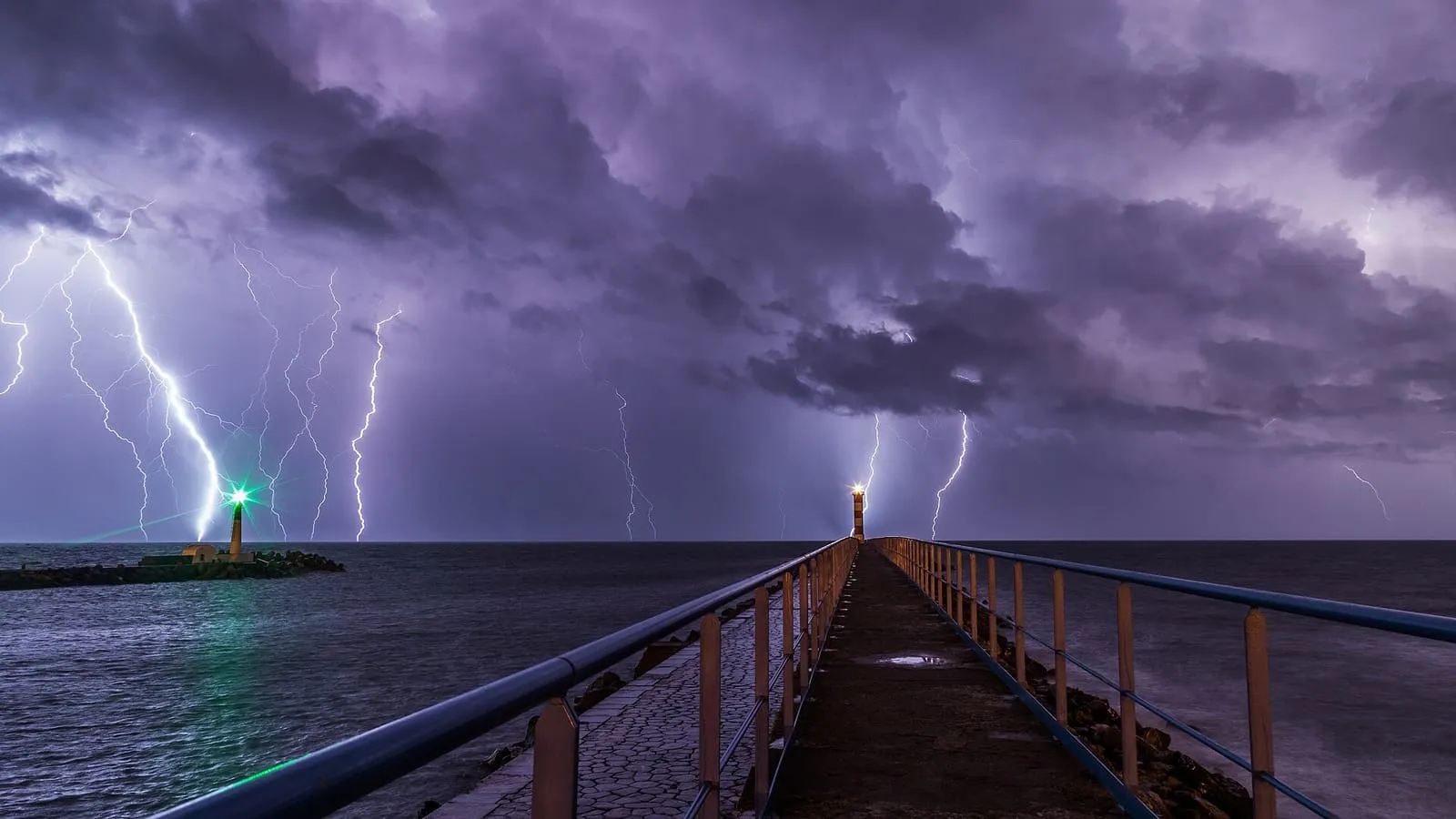
How does lightning strike?
In the early stages of development, the air acts as an insulator between the positive and negative charges inside the cloud and between the cloud and the ground. When the difference between the charges becomes very large, the air’s insulation breaks down and a rapid electrical discharge occurs, which is lightning.
A bolt can leap between opposite charges within the storm cloud, or between the cloud and opposite charges down on the ground. Cloud-to-ground lightning falls into two different types, depending on the charge of the cloud the lightning comes from.
How does thunder form?
As lightning passes through the air, it heats the air rapidly. This makes the air expand quickly and creates the sound wave that we hear as thunder.
Thunder can normally be heard from about 10 miles away from where the lightning flashes. Because lightning can strike up to 10 miles out from a storm, if you can hear thunder you are probably within striking range of the storm.
How hot is lightning, and how far away is it?
The temperature of lightning depends on what it passes through. As lightning passes through the air, it can heat it to 50,000 degrees Fahrenheit, which is about 5 times hotter than the surface of the Sun.
Thunder’s sound covers about a mile in 5 seconds. Count the seconds between the lightning flash and the thunderclap, divide by 5, and you have the lightning’s distance in miles. For example, 10 seconds means 2 miles away.
If you can hear thunder, even a distant rumble, you are in danger of falling victim to lightning.
Test yourself
Three questions from the article. Pick an answer to find out.
Question 1 of 3
How do the lighter ice crystals in a storm cloud become charged?
Lighter ice crystals pick up a positive charge, and the updraft lifts them to the top of the storm. Source: weather.gov
Show answer
Right answer: They become positively charged
Lighter ice crystals pick up a positive charge, and the updraft lifts them to the top of the storm. Source: weather.gov
Question 2 of 3
Roughly how many seconds does it take for the sound of thunder to travel a mile?
Thunder's sound covers about a mile in 5 seconds. Source: weather.gov
Show answer
Right answer: About 5 seconds
Thunder's sound covers about a mile in 5 seconds. Source: weather.gov
Question 3 of 3
To roughly what temperature in degrees Fahrenheit can lightning heat the air as it passes through?
As lightning passes through the air, it can heat it to 50,000 degrees Fahrenheit. Source: weather.gov
Show answer
Right answer: About 50,000 degrees
As lightning passes through the air, it can heat it to 50,000 degrees Fahrenheit. Source: weather.gov