What are sunspots and why do they form?
What is a sunspot?
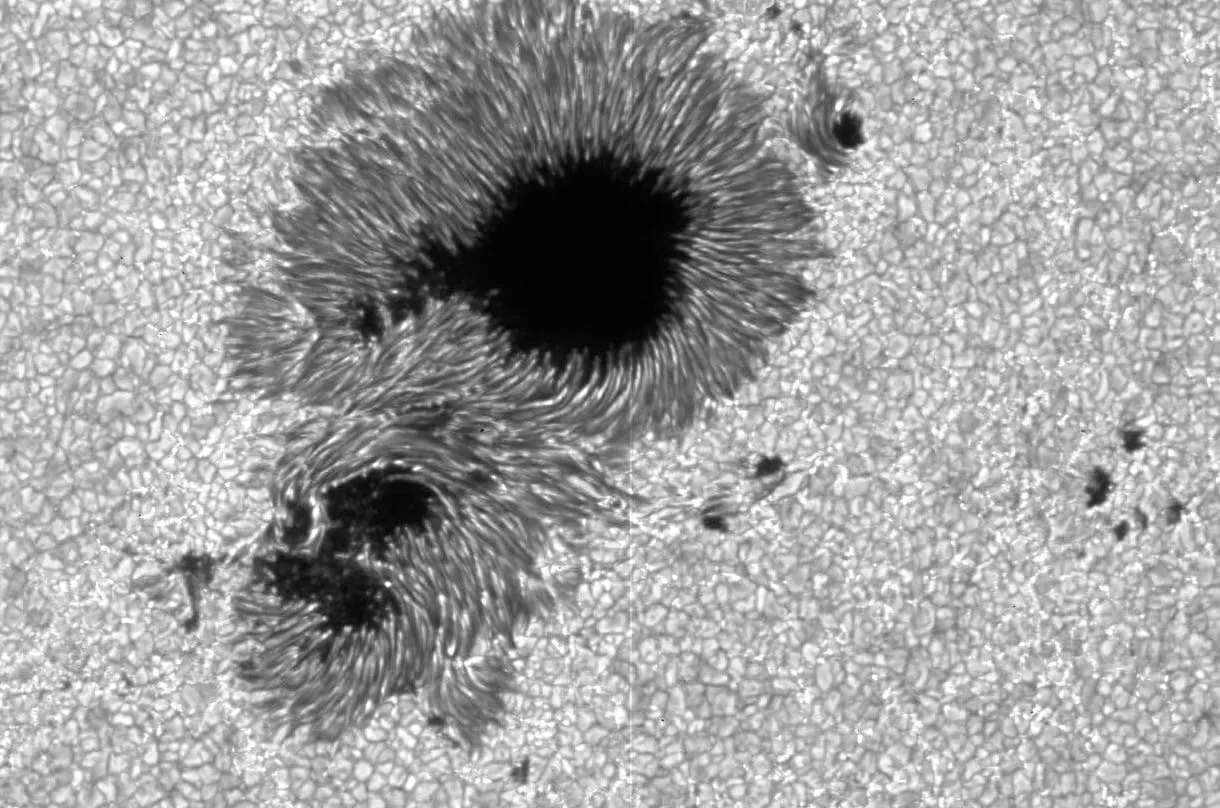
Sunspots look like dark holes on the Sun, but they are really areas that are slightly cooler than the photosphere around them. They form where the Sun’s magnetic field reaches from the interior out into the solar atmosphere. They can last from days to months, and their sizes range from 1600 to 160,900 kilometres.
Galileo was the first European known to observe the Sun with a telescope, and he recorded sunspots in the seventeenth century. Sunspots are always changing: some last only a few hours to days, while those in denser groups can last for months.
The structure of a sunspot
Sunspots come in a wide variety of shapes and forms. A spot can grow from a single-polarity spot into better organised bipolar groups, or even into huge, very complex groups. The darkest part of a sunspot is called the umbra. As the spot matures, a penumbra develops around the umbra, less dark and with a fine, fibrous structure. The biggest groups can spread over huge stretches of the Sun’s surface, each one several times larger than Earth.
Sunspots often appear in pairs, one like the north pole of a magnet and the other like the south pole. The two are linked by loops of magnetic field that arch out of the Sun’s corona.
The solar cycle
The total number of sunspots rises and falls in a repeating pattern of about 11 years, known as the solar cycle. The peak of spot activity is called solar maximum and the lull is called solar minimum.
Solar cycles are numbered in sequence, starting with Cycle 1 in 1755. Cycle 24 started in December 2008 and reached its peak in April 2014, then came to an end in December 2019, which is also when Cycle 25 began. A new cycle is considered to have begun when spot groups appear at higher latitudes with magnetic polarities reversed from the leading spots of the previous cycle.
Why do sunspots matter?
Space weather events such as solar flares and coronal mass ejections most likely start with quick shifts in how the magnetic field is aligned in the active regions tied to sunspot groups. Communication systems and satellites on Earth are affected by sunspot activity.
When spots are counted, each spot group counts as 10 and each umbra within a group counts as 1. So when the visible Sun has no spots at all, the count is zero, and the next possible count is 11 or higher. Clearly seen spot groups are given a 4-digit NOAA/SWPC region number so they can be recorded and tracked as they rotate across the solar disc. WDC-SILSO, at the Royal Observatory of Belgium, is the body that sets the official daily and monthly sunspot numbers.
Test yourself
Three questions from the article. Pick an answer to find out.
Question 1 of 3
Why do sunspots look dark?
Sunspots look dark because they are about 2000 degrees Celsius cooler than the solar surface around them. Source: NASA
Show answer
Right answer: They are about 2000 degrees Celsius cooler than the surface around them
Sunspots look dark because they are about 2000 degrees Celsius cooler than the solar surface around them. Source: NASA
Question 2 of 3
Over roughly how many years does the number of sunspots rise and fall?
The total number of sunspots follows a repeating pattern of about 11 years, called the solar cycle. Source: spaceweather.gov
Show answer
Right answer: About 11 years
The total number of sunspots follows a repeating pattern of about 11 years, called the solar cycle. Source: spaceweather.gov
Question 3 of 3
What is the darkest part of a sunspot called?
The darkest part of a sunspot is known as the umbra. Source: spaceweather.gov
Show answer
Right answer: The umbra
The darkest part of a sunspot is known as the umbra. Source: spaceweather.gov