How did the volcano under Yellowstone form?
What is a hot spot?
Yellowstone sits on a hot spot: a region of unusually high temperatures and some melting in the upper mantle. The intense heat from the hot spot melts the crust and produces basaltic and rhyolitic magma. Rhyolite is very rich in silica, which makes it extremely sticky and stops gas from escaping the magma. This is why large explosive eruptions can happen when a lot of rhyolite builds up in the crust.
The trail of calderas
The hot spot stays fixed in Earth’s mantle while the plates that make up the surface slide over it. Relative to the nearly stationary hot spot, the North American plate is moving southwest at about 2.5 centimetres a year. That is why the eruption centres get younger toward the northeast.
A trail of calderas runs from northern Nevada and eastern Oregon to Yellowstone National Park. The oldest caldera in this trail formed 16 million years ago, while the youngest, the Yellowstone caldera, formed 631,000 years ago. Yellowstone’s volcanic activity is the latest chapter of a 17-million-year history that moved from southwest to northeast across the Snake River Plain. The older calderas can no longer be seen, because they lie under younger basalt lava flows and sediment covering the Snake River Plain.
What happened at Yellowstone?
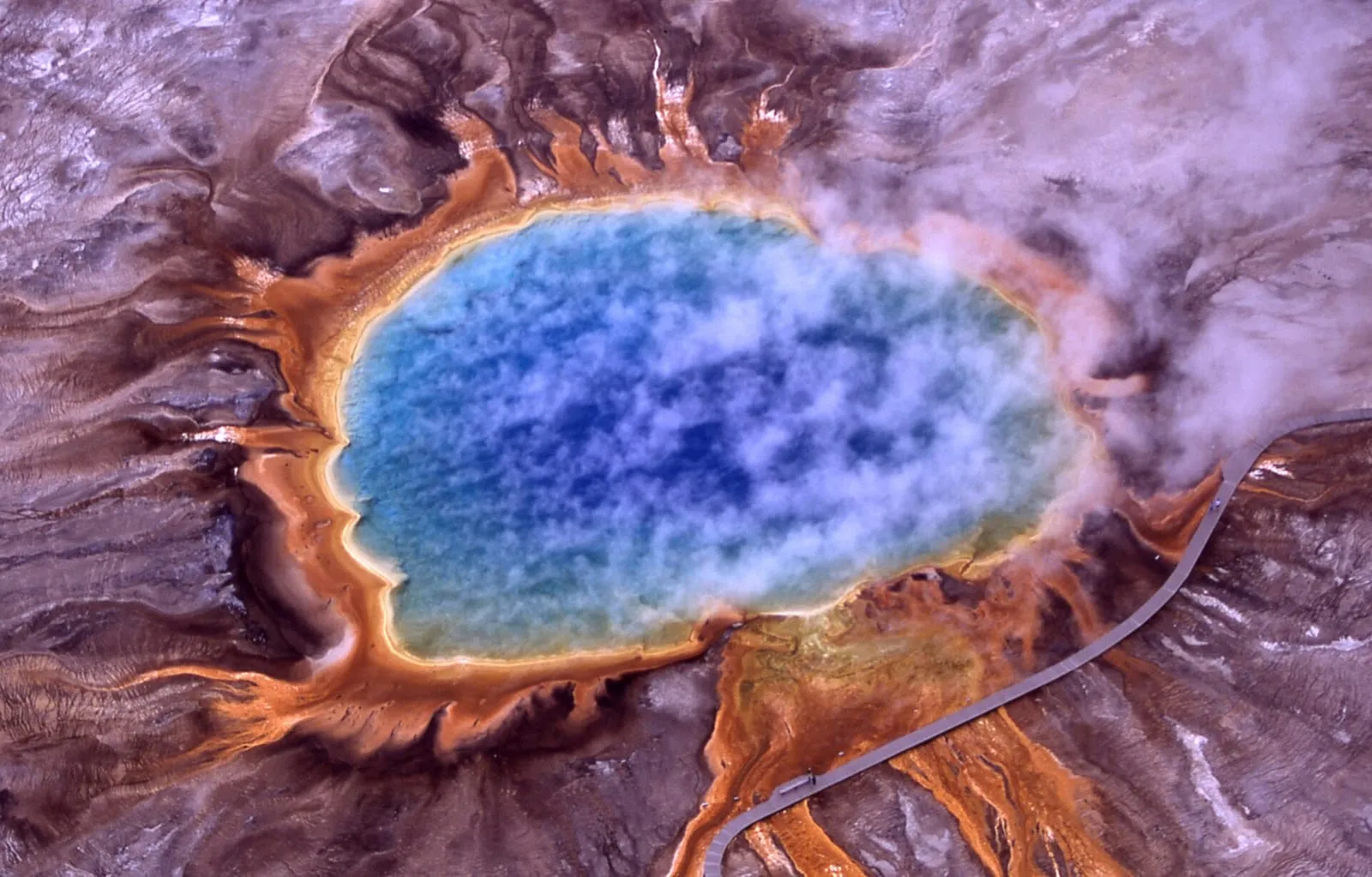
Around 2.1 million years ago, drifting of the North American plate moved the Yellowstone area nearer to a shallow pool of magma. Plumes of magma rising from the mantle melt rock in the crust and create magma chambers of partly molten, partly solid rock. Yellowstone has two such chambers near its surface.
As magma escaped, the pressure in the chamber dropped, and volcanic gases expanded explosively, driving a huge eruption. Once the underground magma chamber had emptied, the ground above it collapsed and the first of Yellowstone’s three calderas formed.
Three great eruptions
In the past 2.1 million years there have been three extraordinarily large explosive eruptions, each creating a giant caldera. In these eruptions hot ash, pumice and other rock fragments piled up and fused into wide sheets of hard rock. From oldest to youngest, these sheets are known as the Huckleberry Ridge, Mesa Falls and Lava Creek tuffs. So much magma came out in each eruption that the roof of the magma storage zones fell in, and the ground above sank by hundreds of metres.
Where does the heat come from?
It has long been suspected that the heat beneath Yellowstone comes from a column-like source. A new study of earthquake waves found evidence of a column 350 kilometres across, stretching from the boundary between the core and the mantle to the base of the crust at Yellowstone. These data are open to interpretation and are only a good starting point for further research.
Test yourself
Three questions from the article. Pick an answer to find out.
Question 1 of 3
Why can rhyolite magma lead to explosive eruptions?
Rhyolite is very rich in silica, which makes it extremely sticky and stops gas from escaping the magma. Source: USGS
Show answer
Right answer: It is high in silica, so it is sticky and stops gas escaping
Rhyolite is very rich in silica, which makes it extremely sticky and stops gas from escaping the magma. Source: USGS
Question 2 of 3
In which direction do the eruption centres along the hot spot's caldera trail get younger?
The eruption centres get younger toward the northeast. Source: USGS
Show answer
Right answer: Toward the northeast
The eruption centres get younger toward the northeast. Source: USGS
Question 3 of 3
How many extraordinarily large explosive eruptions have there been in the past 2.1 million years?
In the past 2.1 million years there have been three extraordinarily large explosive eruptions, each creating a giant caldera. Source: USGS
Show answer
Right answer: Three
In the past 2.1 million years there have been three extraordinarily large explosive eruptions, each creating a giant caldera. Source: USGS