How did Mount St. Helens erupt in 1980?
Warning signs
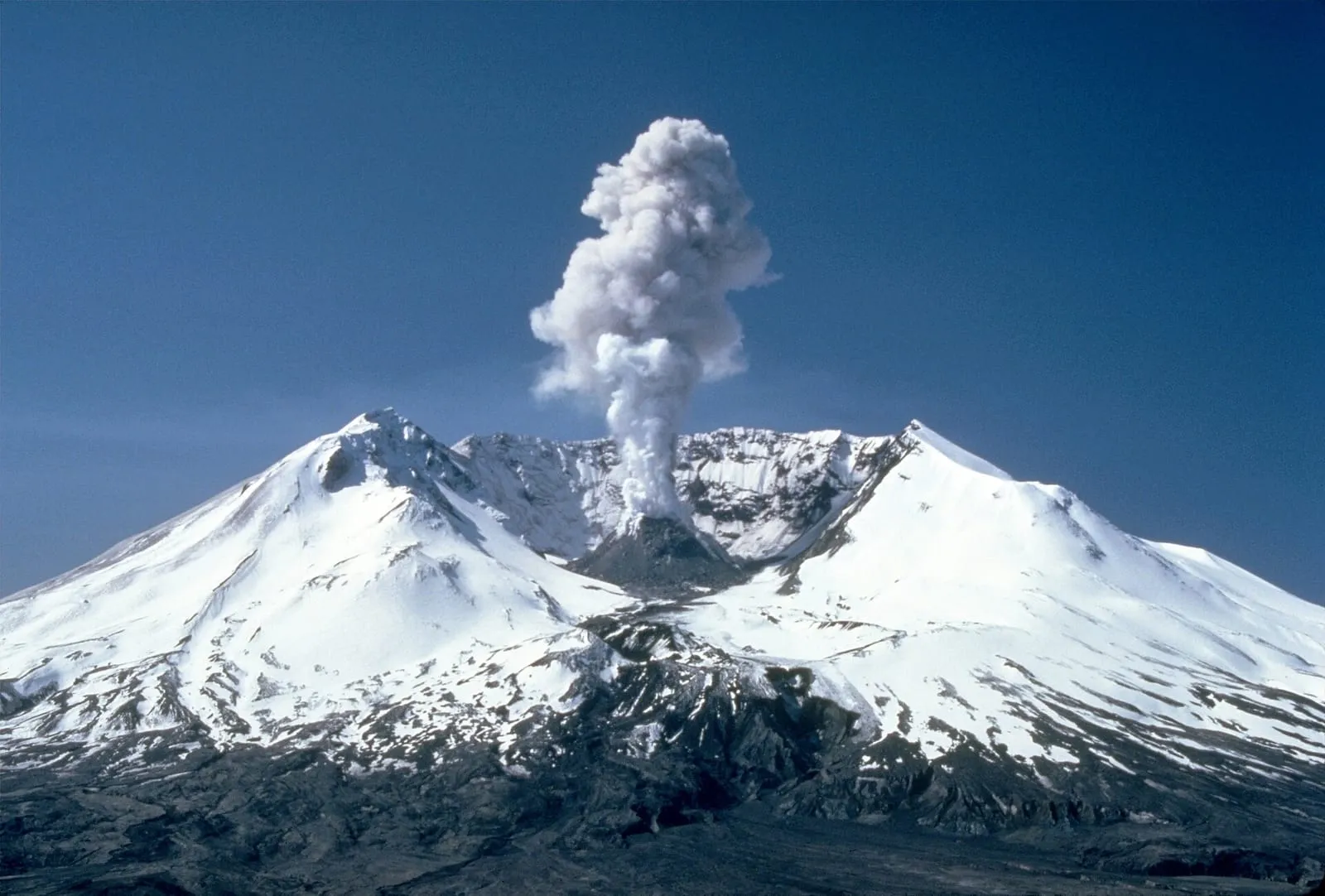
The first sign of activity at Mount St. Helens came on 16 March 1980, as a series of small earthquakes. On 27 March, after hundreds more earthquakes, the volcano made its first eruption in more than 100 years. Steam explosions opened a crater 60 to 75 metres wide in the ice cap on the summit.
As magma moved into the volcano, a bulge grew on the north flank. By 17 May, more than 10,000 earthquakes had shaken the volcano and the north flank had pushed outward by about 140 metres. Such dramatic change in shape was strong evidence that molten rock had risen high inside the volcano.
The morning of 18 May
At 8:32 a.m. on 18 May 1980, a magnitude 5.1 earthquake struck. At the same moment, the volcano’s northern bulge and summit slid away in a huge landslide. This landslide was the largest debris avalanche in recorded history on Earth. It also removed part of a very hot, highly pressurised body of magma that had grown inside the volcano.
The sideways blast
With the summit gone, the pressure on the volcano dropped in an instant. Hot water in the system turned to steam and expanded explosively, setting off a blast directed sideways. The sideways blast caught up with the landslide and sped up to at least 300 miles per hour. It devastated an area stretching about 30 kilometres to the north.
The ash column and mudflows
A few minutes later, an eruption cloud began to rise from the old summit crater. In under 15 minutes the cloud had reached a height of more than 24 kilometres. The eruption fed a towering column of ash for more than nine hours. Magma rose, formed bubbles and erupted explosively, driving a Plinian eruption that lasted nine hours.
Winds carried the ash hundreds of miles away. Volcanic mudflows called lahars carried large boulders and logs. These events caused 57 deaths and made it the worst volcanic disaster in the recorded history of the contiguous states of the US.
The effect on science
Mount St. Helens was the first large explosive eruption studied using modern volcanology. The eruption sped up interest in studying explosive eruptions and in monitoring work to improve warning systems. Until 1980, scientists treated volcano hazard studies, monitoring and basic research as sharply separate fields. The eruption forced scientists to work together in a more joined-up way. Today, many instruments, satellites among them, can track earthquakes, changes in shape and gases at volcanoes.
Test yourself
Three questions from the article. Pick an answer to find out.
Question 1 of 3
What happened at Mount St. Helens at 8:32 a.m. on 18 May 1980?
At 8:32 a.m. on 18 May 1980, a magnitude 5.1 earthquake struck. Source: USGS
Show answer
Right answer: A magnitude 5.1 earthquake struck
At 8:32 a.m. on 18 May 1980, a magnitude 5.1 earthquake struck. Source: USGS
Question 2 of 3
Which statement about the landslide is correct?
The landslide was the largest debris avalanche in recorded history on Earth. Source: USGS
Show answer
Right answer: It was the largest debris avalanche in recorded history on Earth
The landslide was the largest debris avalanche in recorded history on Earth. Source: USGS
Question 3 of 3
Why was this eruption important for science?
Mount St. Helens was the first large explosive eruption studied using modern volcanology. Source: USGS
Show answer
Right answer: It was the first large explosive eruption studied with modern volcanology
Mount St. Helens was the first large explosive eruption studied using modern volcanology. Source: USGS