How was the Grand Canyon formed?
The rock layers
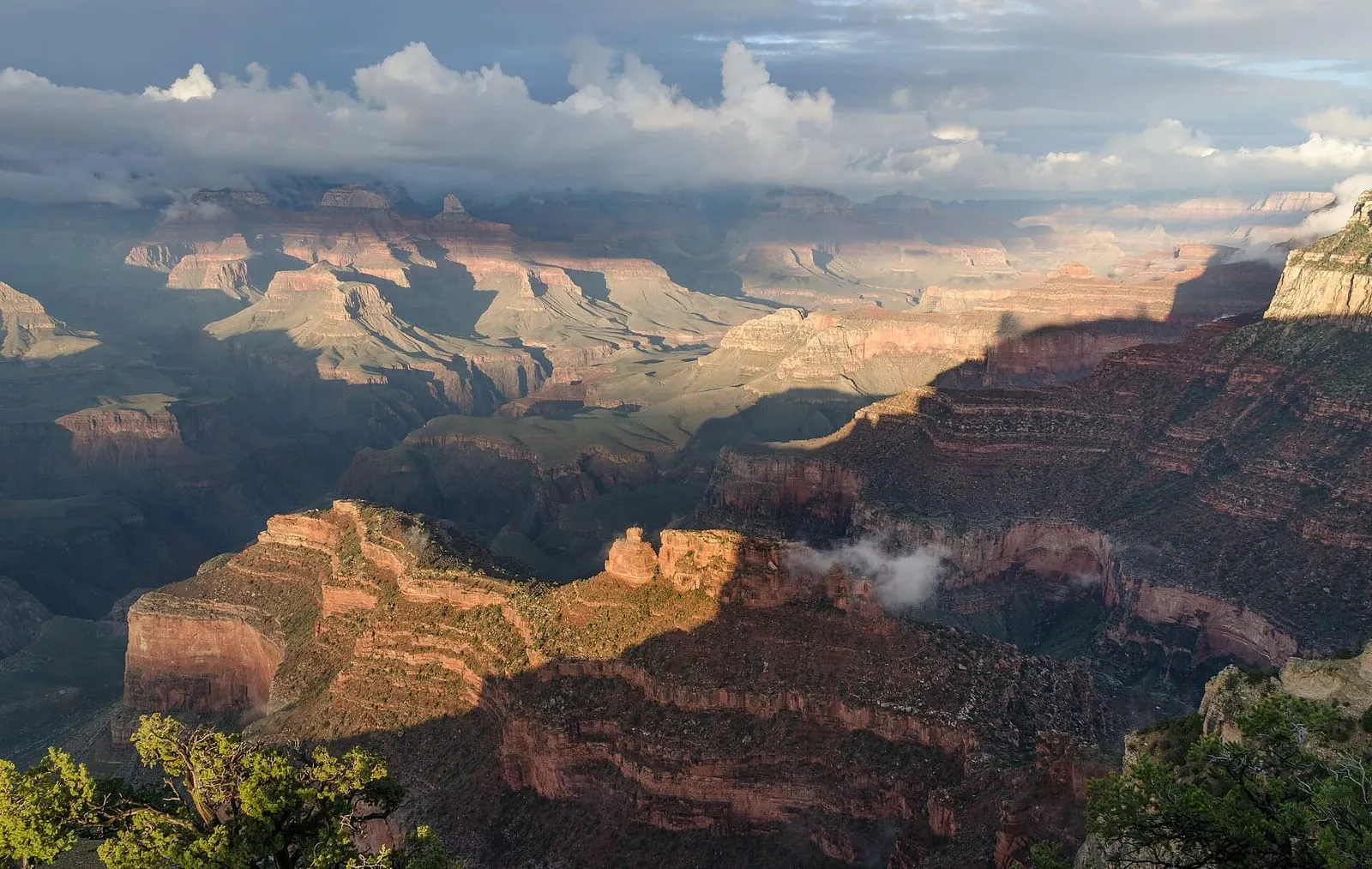
The making of the Grand Canyon can be remembered in four steps: Deposition, Uplift, Downcutting and Erosion. The story begins about two billion years ago, when the igneous and metamorphic rocks of the inner gorge formed. On top of these ancient rocks lie layer upon layer of sedimentary rock, each telling a different part of the region’s environmental history. To read the layers, geologists use a diagram called a stratigraphic column, which shows the oldest layer at the bottom and the youngest at the top.
How did the plateau rise?
70 to 30 million years ago, plate tectonics lifted the whole region and produced the high, fairly flat Colorado Plateau. Kaibab Limestone, the top rock layer of the Grand Canyon, is now found at heights of up to 9,000 feet on the Colorado Plateau. The rise of the plateau created a high surface that the Colorado River could cut down into.
Exactly how the plateau rose is puzzling, and it is still being studied. Scientists do not know exactly how the uplift happened, but a few hypotheses have been put forward.
How did the river carve the canyon?
The Grand Canyon is arguably the finest example of a canyon cut by water. No glaciers ever existed in or near the Grand Canyon.
The Colorado River has been wearing away rock for the past five to six million years. The canyon is far younger than the rocks it runs through. Geologists call the process that forms a canyon downcutting.
Downcutting happens during floods, when large rocks and boulders are carried along and act like chisels, knocking pieces off the riverbed as they bounce downstream. Downcutting is stronger in the Grand Canyon for several reasons: the Colorado River drops steeply, carries a great deal of water and runs through arid country. On its 277-mile journey through the Grand Canyon, the Colorado River drops about 2,000 feet. Erosion by streams flowing in from the sides widened the canyon.
Is the canyon still changing?
The erosion that formed the canyon is still going on today; the Colorado River and its tributaries are slowly cutting the canyon deeper. In the western Grand Canyon, hundreds of volcanic eruptions have taken place over the past two million years. At least twelve times, lava poured down the walls of the inner gorge and built huge lava dams that blocked the Colorado River.
Three of these lava dams were more than 1,000 feet high. Some of the lakes behind them were more than 100 miles long and filled the lower part of the canyon for years.
Test yourself
Three questions from the article. Pick an answer to find out.
Question 1 of 3
For roughly how long has the Colorado River been carving the Grand Canyon?
The Colorado River has been wearing away rock for the past five to six million years. Source: www.nps.gov
Show answer
Right answer: For the past five to six million years
The Colorado River has been wearing away rock for the past five to six million years. Source: www.nps.gov
Question 2 of 3
How does the Grand Canyon compare with the rocks it runs through?
The canyon is far younger than the rocks it runs through. Source: www.nps.gov
Show answer
Right answer: It is far younger than the rocks
The canyon is far younger than the rocks it runs through. Source: www.nps.gov
Question 3 of 3
Was the Grand Canyon carved by glaciers?
No glaciers ever existed in or near the Grand Canyon. Source: www.nps.gov
Show answer
Right answer: No, no glaciers ever existed in or near it
No glaciers ever existed in or near the Grand Canyon. Source: www.nps.gov