Orionid meteor shower: what it is, when and how to watch
Where do Orionid meteors come from?
Orionid meteors appear when Earth passes, every year, through a region of space filled with debris left behind by Halley’s Comet. The dust that comets give off as they pass around the Sun gradually spreads out into a dusty trail along their orbits. Earth passes through these trails every year; the particles hit the atmosphere and break apart, creating bright, colourful streaks in the sky.
Whenever Halley comes back to the inner Solar System, its nucleus gives off ice and rocky dust into space. When these dust grains hit Earth’s atmosphere, they become the Orionids in October and the Eta Aquariids in May. Most of these fragments range in size from a grain of sand to a pea, and they burn up in the atmosphere before they can reach the ground.
Halley’s Comet takes about 76 years to complete one orbit of the Sun. Casual observers last saw Halley in 1986; the comet will not enter the inner Solar System again until 2061. The comet is named after Edmond Halley, who noticed in 1705 that three earlier comets seemed to return roughly every 76 years.
Why are they called “Orionids”?
The point in the sky from which meteors appear to come is called the radiant; the radiant of the Orionids is the constellation Orion. The shower also takes its name from this constellation. The constellation only helps viewers work out which shower they are watching on a given night. The meteors do not actually come from the constellation.
When can you see them, and how many?
The Orionids peak in mid-October every year and are considered one of the most beautiful meteor showers of the year. In 2026, the Orionids are active from 2 October to 7 November; the peak night is 21–22 October. Under a dark sky, you can see about 10 to 20 meteors per hour.
Orionids are known for being bright and fast; they enter the atmosphere at about 66 kilometres per second. Fast meteors can leave glowing trails behind them that last from a few seconds to a few minutes. Sometimes they can also turn into fireballs, creating long-lasting bursts of light.
How can you watch them?
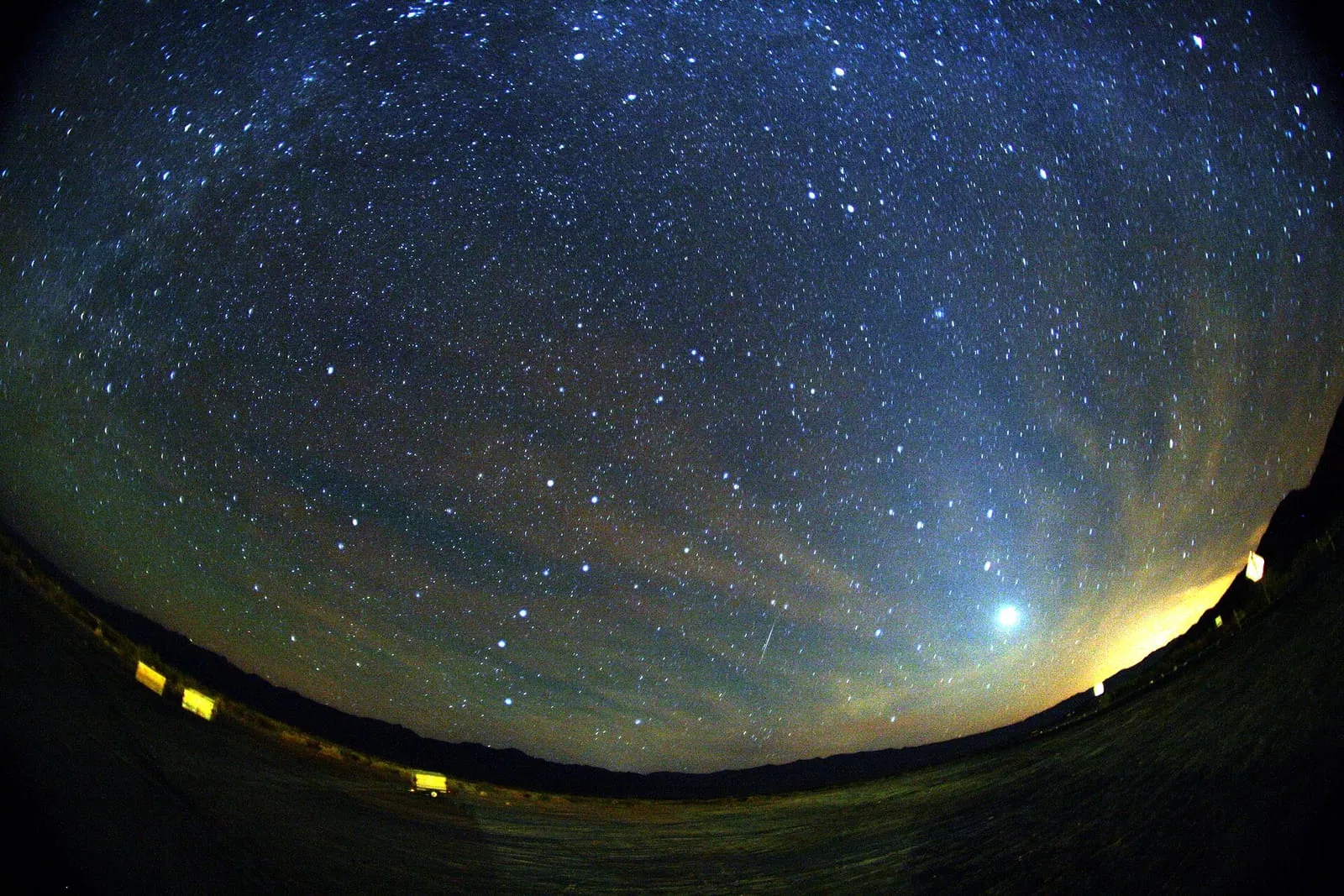
The Orionids can be seen from both the Northern and Southern hemispheres in the hours after midnight. To watch them, you need to find a place well away from the city and street lights. It is a good idea to bring a sleeping bag, a blanket or a folding chair. In the Northern Hemisphere, lie flat on your back with your feet pointing south-east and try to take in as much of the sky as possible.
In the dark, your eyes adjust in less than 30 minutes and you start to see meteors. You need to be patient; the show lasts until dawn.
You don’t need to look only at Orion either: the Orionids can be seen all across the sky. It is better to look 45 to 90 degrees away from the radiant; from there the meteors look longer. If you look straight at the radiant, the meteors look short; this is an effect of perspective.
Test yourself
Three questions from the article. Pick an answer to find out.
Question 1 of 3
Roughly how many years does Halley's Comet take to go once around the Sun?
Halley's Comet completes one trip around the Sun in about 76 years. Source: NASA
Show answer
Right answer: About 76 years
Halley's Comet completes one trip around the Sun in about 76 years. Source: NASA
Question 2 of 3
Under a dark sky, roughly how many Orionid meteors can you see per hour?
Under a dark sky you can see roughly 10 to 20 meteors an hour. Source: NASA
Show answer
Right answer: 10 to 20
Under a dark sky you can see roughly 10 to 20 meteors an hour. Source: NASA
Question 3 of 3
How long does it take for your eyes to adjust to the dark so you can start seeing meteors?
In the dark, your eyes adjust in less than 30 minutes and the meteors start to appear. Source: NASA
Show answer
Right answer: Less than 30 minutes
In the dark, your eyes adjust in less than 30 minutes and the meteors start to appear. Source: NASA