What is a light-year and how many kilometres is it?
What is a light-year?
A light-year measures how far light travels during a single Earth year. A single light-year comes to roughly 6 trillion miles (9 trillion kilometres).
For most objects in space, we give their distance in light-years. A light-year is how far a particle of light, a photon, travels in a year: roughly 6 trillion miles (9 trillion kilometres, or 63,000 AU).
Why are we looking back in time?
Light moves at 186,000 miles (or 300,000 kilometres) per second. When we point powerful telescopes at distant objects in space, we are really looking back in time.
The farther away an object is, the further in the past we see it. The deeper we look into space, the further back in time we look.
The closest star to us is the Sun, about 93 million miles away. Sunlight takes about 8.3 minutes to reach us. The Sun is around 8 light-minutes from Earth.
Examples close to home
The second-closest star to us is about 4.3 light-years away. When we see that star today, we are actually seeing it as it was 4.3 years ago. The nearest star system to ours is the triple system Alpha Centauri. Every other star we can see with the naked eye is farther off, and some are thousands of light-years away.
Andromeda, the nearest large galaxy to us, is 2.5 million light-years away. So we see Andromeda as it was 2.5 million years ago.
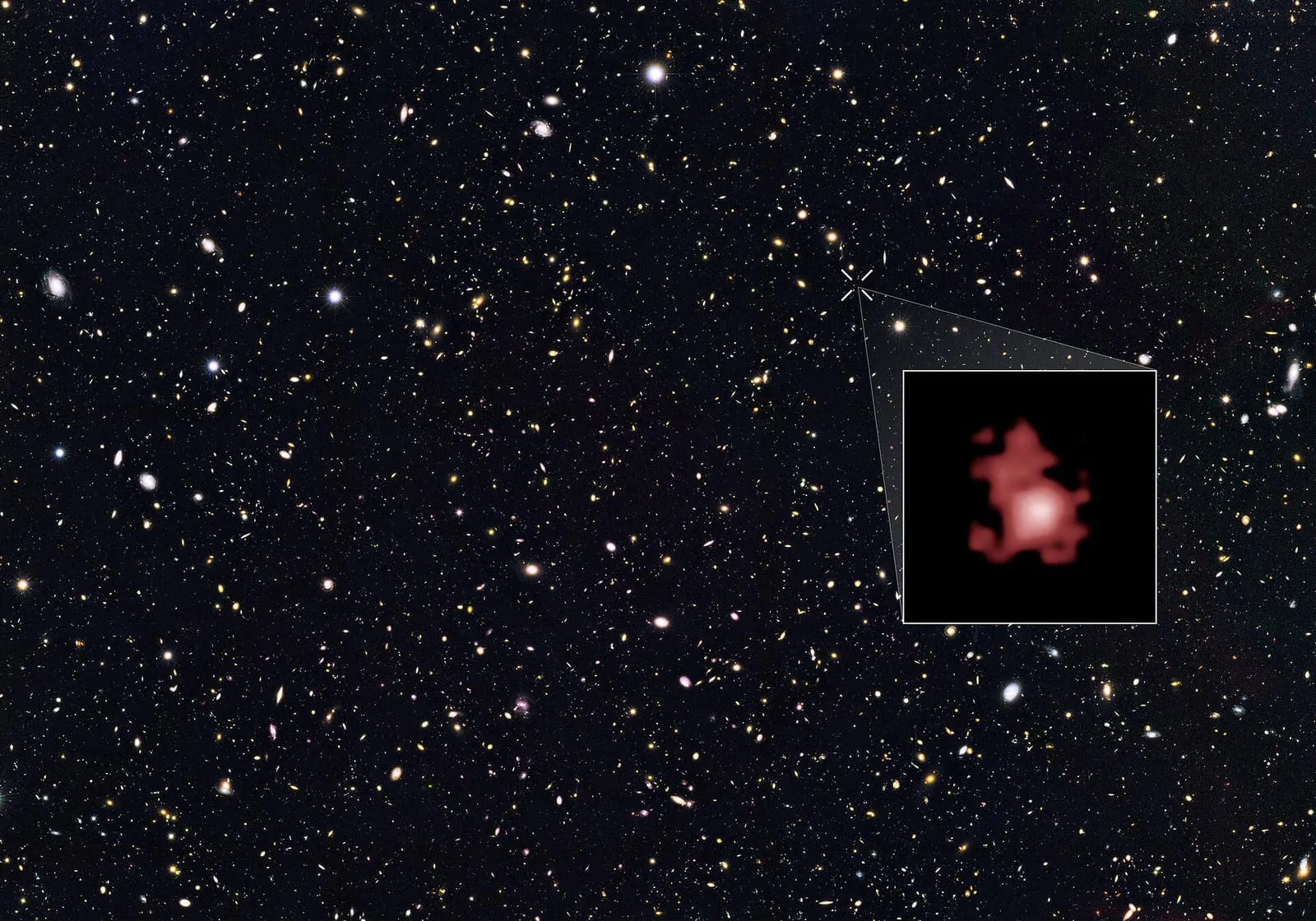
Back in 2016, NASA’s Hubble Space Telescope turned to GN-z11, the most distant galaxy ever seen. It lies 13.4 billion light-years away, so today we see it as it was 13.4 billion years ago. This is just 400 million years after the Big Bang. It is one of the first galaxies to have formed in the universe.
Studying these earliest galaxies, formed after the Big Bang, helps us understand what the early universe was like. Stars come in huge groups called galaxies. A galaxy can hold millions or even billions of stars.
Other units of distance
Astronomical units (AU) are a handy unit inside the Solar System. An AU is the gap between the Sun and Earth’s orbit, about 93 million miles (150 million kilometres). Astronomical units make it simple to see that Jupiter circles the Sun at five times Earth’s distance, and Saturn at twice Jupiter’s. For much larger, interstellar distances, astronomers use light-years.
Like AU, light-years make cosmic distances easier to handle. One parsec is 3.26 light-years. One megaparsec is 1 million parsecs.
Test yourself
Three questions from the article. Pick an answer to find out.
Question 1 of 3
About how many kilometres is one light-year?
One light-year is roughly 6 trillion miles, which is 9 trillion kilometres. Source: NASA
Show answer
Right answer: About 9 trillion kilometres
One light-year is roughly 6 trillion miles, which is 9 trillion kilometres. Source: NASA
Question 2 of 3
What does the light-year measure?
A light-year measures how far light goes in a year on Earth. Source: NASA
Show answer
Right answer: Distance
A light-year measures how far light goes in a year on Earth. Source: NASA
Question 3 of 3
How do we see a very distant object?
The farther away an object is, the further back in the past we see it. Source: NASA
Show answer
Right answer: As it was in the past
The farther away an object is, the further back in the past we see it. Source: NASA