Does lightning never strike the same place twice?
Verdict: false
The saying that lightning never strikes the same place twice appears in the source as a myth. In fact lightning often returns to the same spot, particularly tall, pointy and isolated objects. On average the Empire State Building takes 23 strikes every year.
Where does lightning land?
The main factors that determine where lightning lands are height, a pointed shape and isolation. Whether metal is present makes no difference to where it strikes. Natural features that are tall and isolated yet contain little or no metal, such as trees and mountains, are also hit many times a year.
Standing under a tree is the second most common cause of injuries from lightning.
What kind of event is a lightning flash?
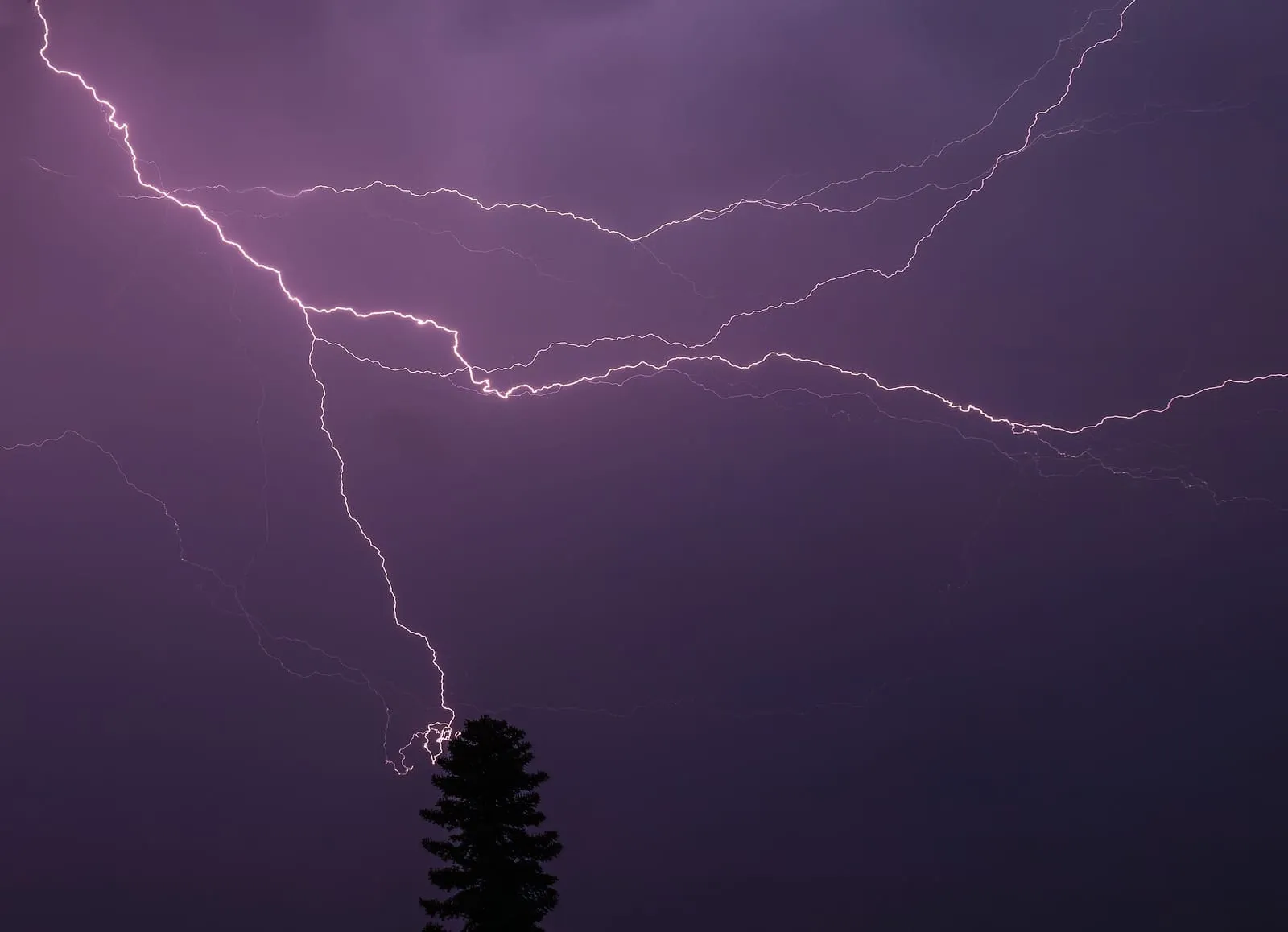
A full lightning flash, from start to finish, lasts about 0.2 seconds. Most flashes consist of several shorter discharges, each under a millisecond long, and the eye cannot tell these repeated events apart. Each of these separate discharges is called a stroke. When the strokes are spaced far enough apart in time, the eye can pick them out and the lightning seems to flicker.
According to Williams, a typical lightning bolt spans a potential difference of several hundred million volts. Most current measurements fall between 5,000 and 20,000 amps. In 1971, shortly ahead of the Apollo 15 launch, a famous strike was clocked at 100,000 amps using magnetic links on the launch tower. Lightning reaches temperatures of 15,000 to 60,000°F. For a single stroke, the current usually ends in about a millisecond. Williams also says that a moderate thunderstorm produces several hundred megawatts of electrical power.
How far away can lightning strike?
Lightning often hits ground more than three miles from the centre of the storm, well outside the rain and the storm cloud. Bolts from a clear sky can land 10 to 15 miles from the thunderstorm. Older data put successive flashes 3 to 4 km apart, but newer data show that half of all flashes are about 9 km apart.
Many cloud-to-ground flashes touch down at forked or multiple points on the ground. Sideways arcing has been measured at least 20 metres from the point where lightning meets the ground. At Cape Canaveral, lightning has been recorded travelling almost 90 miles outward through a thunderstorm anvil.
Crouching outdoors does not make you any safer. Lying flat raises the chance of being affected by dangerous current in the ground. Many of those hurt by lightning are people who did not look for shelter early enough.
Test yourself
Three questions from the article. Pick an answer to find out.
Question 1 of 3
On average, how many times a year is the Empire State Building struck by lightning?
The Empire State Building is struck by lightning 23 times a year on average. Source: weather.gov
Show answer
Right answer: About 23 times
The Empire State Building is struck by lightning 23 times a year on average. Source: weather.gov
Question 2 of 3
What are the main factors that decide where lightning lands?
The main factors that decide where lightning lands are height, a pointed shape and isolation. Source: weather.gov
Show answer
Right answer: Height, pointed shape and isolation
The main factors that decide where lightning lands are height, a pointed shape and isolation. Source: weather.gov
Question 3 of 3
About how long does a whole lightning flash last?
A whole lightning flash lasts about 0.2 seconds. Source: hyperphysics.phy-astr.gsu.edu
Show answer
Right answer: About 0.2 seconds
A whole lightning flash lasts about 0.2 seconds. Source: hyperphysics.phy-astr.gsu.edu