What is a mitochondrion and what does it do?
What is a mitochondrion?
Mitochondria are cell organelles surrounded by membranes that produce most of the chemical energy needed to run the cell’s biochemical reactions. The chemical energy mitochondria make is stored in a small molecule called adenosine triphosphate (ATP). The phosphate in ATP is a high-energy bond, and it supplies energy to other reactions in the cell.
Found in the cytoplasm, mitochondria are where the cell’s energy production and other metabolic functions take place. Pioneering biochemical studies established the idea, long ago, that mitochondria are “the powerhouse of the cell”.
Structure
Mitochondria are enclosed by two different membranes, which is quite unusual for an organelle inside a cell. A double boundary membrane encloses every mitochondrion. The inner membrane is folded many times, and its projections are called cristae.
Mitochondria are the sites of the oxidative phosphorylation reactions that end in the formation of ATP.
More than a powerhouse
According to one review, mitochondria work within a connected network that is constantly reshaped by fusion and fission. The same review says that new evidence shows mitochondria to be an integral part of several cell signalling pathways.
One hypothesis holds that mitochondrial respiration and metabolism may be regulated in space and time by the organelle’s architecture and position. The same review adds that certain proteins connect mitochondrial function and dynamics to the regulation of metabolism, control of the cell cycle, development, antiviral responses and cell death.
Where they sit in the cell, and where they came from
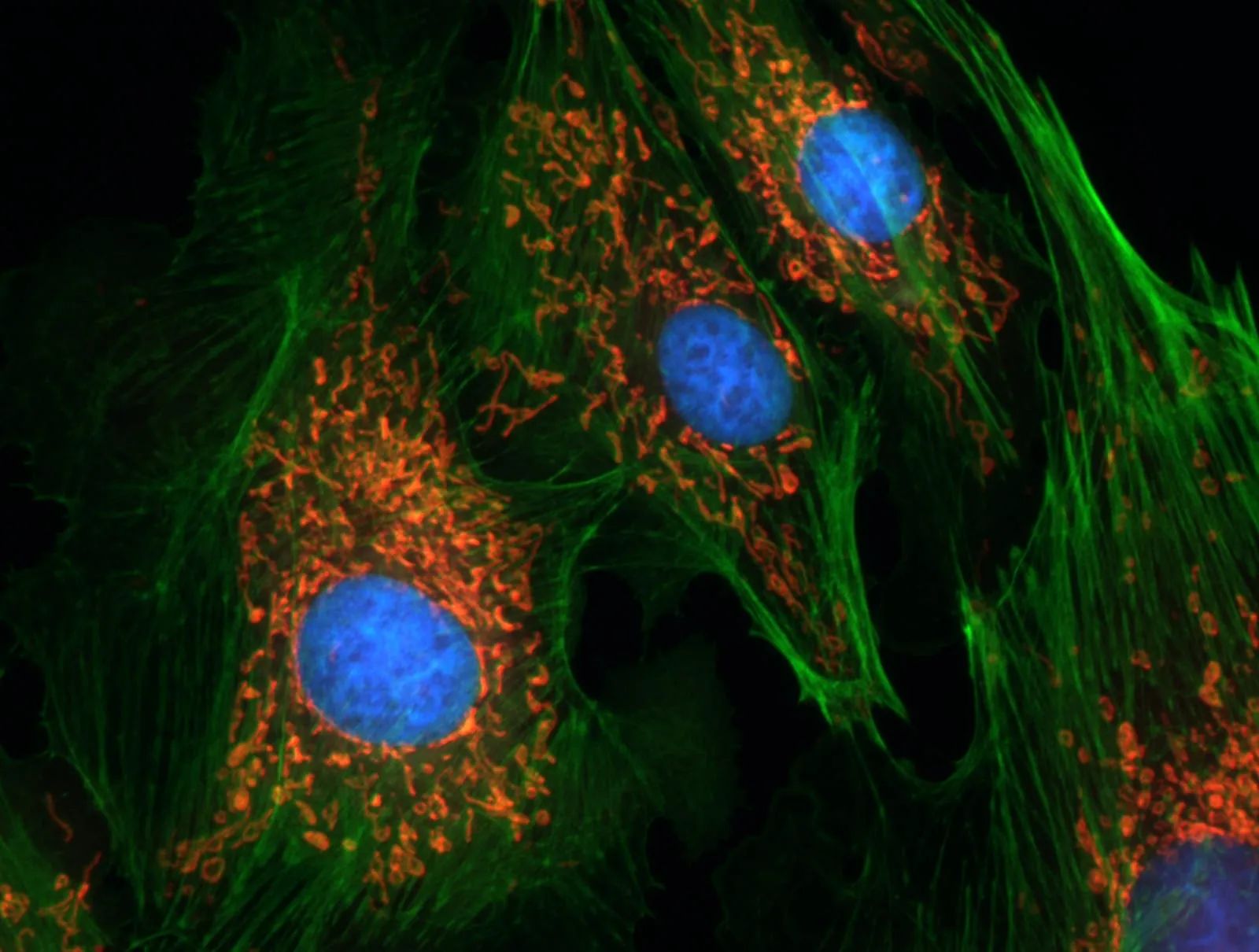
Mitochondria are semi-autonomous, self-replicating organelles found in the cytoplasm of all the cells of most, though not all, eukaryotes. For many essential messenger RNAs, mitochondria depend on genes in the nucleus of the cell they live in.
Mitochondria are believed to have originated from aerobic bacteria that entered a symbiotic relationship with primitive proto-eukaryotes. According to one article, mitochondria keep bacterial traits because of their endosymbiotic origin, yet host cells do not recognise them as foreign because the organelles are kept apart.
Their own DNA
Mitochondria have small chromosomes of their own. Unlike other organelles, mitochondria have DNA of their own. The circular chromosome inside the organelles known as mitochondria is called mitochondrial DNA.
Mitochondria, and therefore mitochondrial DNA, are generally inherited from the mother only. Because you get all your mitochondria from your mother, they can be used to trace your ancestry far back along your mother’s line.
Which cells have more of them?
The amount of mitochondria differs from cell to cell, because cells differ in how much energy they need. Muscle, liver and kidney contain a great many mitochondria; the brain contains them to some extent as well.
Test yourself
Three questions from the article. Pick an answer to find out.
Question 1 of 3
From whom are mitochondria and mitochondrial DNA usually inherited?
In general, mitochondria, and so mitochondrial DNA, are passed down from the mother alone. Source: Genome.gov
Show answer
Right answer: Only from the mother
In general, mitochondria, and so mitochondrial DNA, are passed down from the mother alone. Source: Genome.gov
Question 2 of 3
What kind of membrane surrounds each mitochondrion?
Each mitochondrion is enclosed by two bounding membranes. Source: NIH
Show answer
Right answer: A double bounding membrane
Each mitochondrion is enclosed by two bounding membranes. Source: NIH
Question 3 of 3
Do mitochondria have chromosomes of their own?
Mitochondria have small chromosomes that belong to them. Source: Genome.gov
Show answer
Right answer: Yes, they have small chromosomes of their own
Mitochondria have small chromosomes that belong to them. Source: Genome.gov