Is Neptune the windiest planet in the Solar System?
How fast are the winds?
Neptune is the windiest world in the Solar System. Although it gets little energy from the Sun and is very far away, its winds can be three times as strong as Jupiter’s and nine times as strong as Earth’s.
Those winds drive frozen methane clouds around the planet at over 1,200 miles per hour (2,000 kilometres). Even the strongest winds on Earth reach only about 250 miles per hour (400 kilometres).
What kind of place is Neptune?
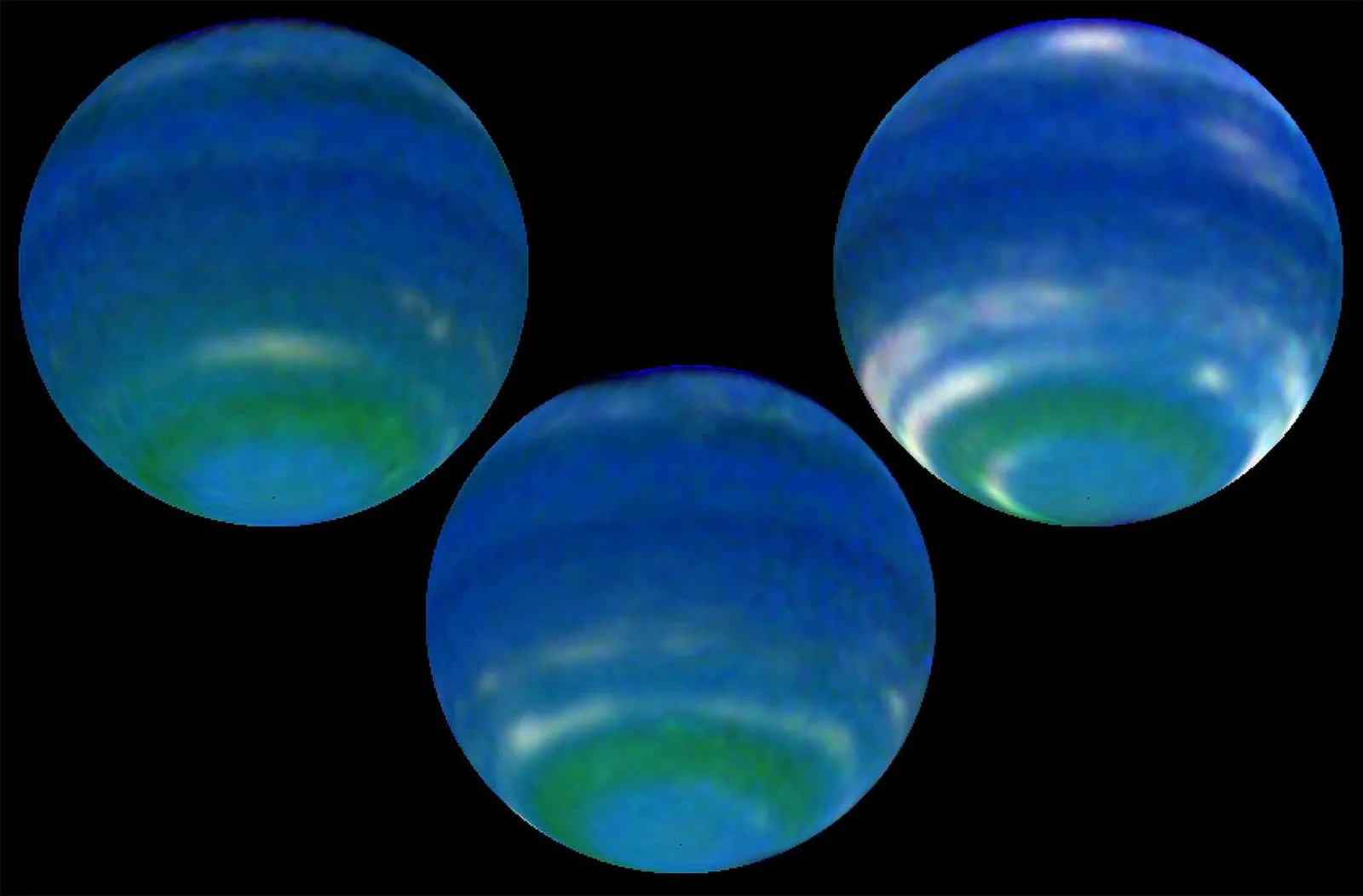
Neptune is an ice giant that is dark, cold and lashed by supersonic winds, and it lies more than 30 times farther from the Sun than Earth does. It is so far from the Sun that noon on this big blue planet would look to us like dim twilight.
Neptune’s width is roughly four times that of Earth. Its magnetic field is about 27 times stronger than Earth’s.
Neptune has no solid surface. Its atmosphere is mostly hydrogen and helium, with only a little methane. Neptune looks blue because methane soaks up other colours and reflects blue.
A day on Neptune lasts about 16 hours. The planet takes about 165 Earth years to travel once around the Sun, which is its own year. Neptune has seasons too, like Earth, yet its year is so long that every one of the four seasons runs for more than 40 years.
How was it found?
Neptune was the first planet to be found by mathematical prediction rather than by regular observation. Johann Gottfried Galle, who received Urbain Le Verrier’s predictions, found Neptune in 1846 on the first night he searched at the Berlin Observatory.
Only the Voyager 2 spacecraft has ever reached Neptune. The planet has 16 known moons.
Pluto’s oval-shaped orbit takes it inside Neptune’s orbit for 20 years out of every 248 Earth years.
Storms and clouds
In 1989, a huge oval storm called the “Great Dark Spot” sat in Neptune’s southern hemisphere, big enough to swallow the whole Earth. That storm later vanished, but new ones have appeared in other parts of the planet.
Astronomers have found a link between how much cloud Neptune has and the 11-year solar cycle. Two years after the peak of the solar cycle, more and more clouds appear on Neptune. According to the theory, the extra ultraviolet radiation from the Sun when it is most active triggers chemical changes deep in Neptune’s atmosphere.
Clouds normally seen at Neptune’s mid-latitudes began to fade in 2019. According to the research team, Neptune has a livelier, more turbulent atmosphere than Uranus, so it is better at mixing methane particles into the haze layer.
Test yourself
Three questions from the article. Pick an answer to find out.
Question 1 of 3
How can Neptune's winds compare with Jupiter's?
Neptune's winds can be three times as strong as Jupiter's and nine times as strong as Earth's. Source: NASA
Show answer
Right answer: Up to three times stronger
Neptune's winds can be three times as strong as Jupiter's and nine times as strong as Earth's. Source: NASA
Question 2 of 3
How many Earth years does a year on Neptune last?
Neptune takes about 165 Earth years to complete one orbit of the Sun. Source: NASA
Show answer
Right answer: About 165 Earth years
Neptune takes about 165 Earth years to complete one orbit of the Sun. Source: NASA
Question 3 of 3
How would noon on Neptune look to us?
Neptune is so far from the Sun that noon there would look to us like dim twilight. Source: NASA
Show answer
Right answer: Like dim twilight
Neptune is so far from the Sun that noon there would look to us like dim twilight. Source: NASA