What is Jupiter's Great Red Spot?
How big is the Great Red Spot?
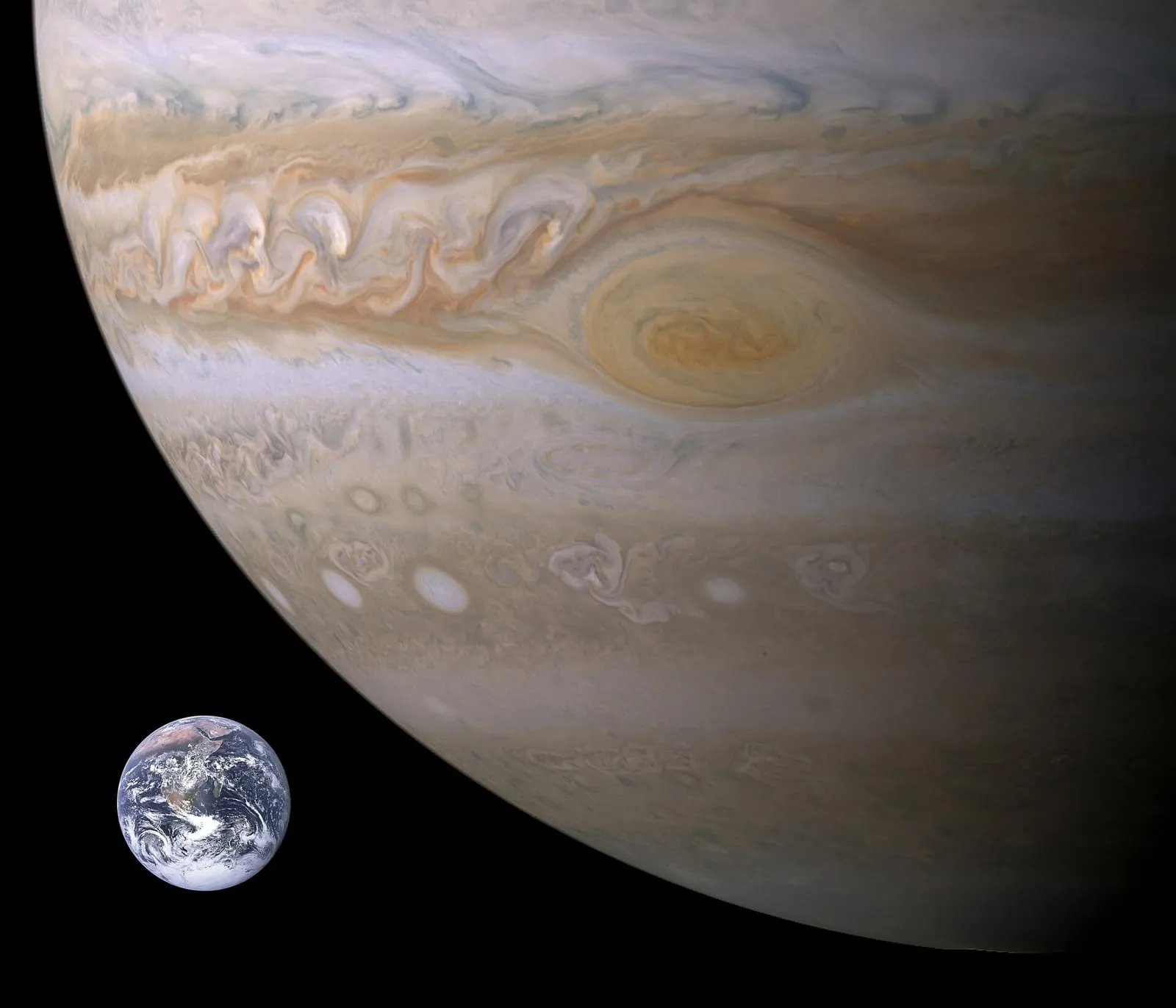
The Great Red Spot is a giant storm on Jupiter, and it is twice as wide as Earth. It measures 12,500 miles across, big enough to fit Earth inside it two or three times.
Its winds reach about 400 miles per hour. The Great Red Spot has been spinning wildly in Jupiter’s skies for the past 150 years, and it may have been spinning for much longer than that.
When people began studying the sky with telescopes in the 1600s, they saw a large spot on Jupiter, but it is still unclear whether it was the same storm.
What kind of storm is it?
The Great Red Spot is an anticyclone wedged between two jet streams, and it turns around a centre of high pressure in the opposite direction to hurricanes on Earth. It sits in the southern hemisphere and is the largest anticyclone on Jupiter.
Jupiter’s stormy atmosphere has about a dozen jet streams flowing alternately east and west, and their speeds can top 330 miles per hour.
Why does it last so long?
Jupiter is a planet a thousand times bigger than Earth, and it is mostly made of gas. Its atmosphere is mostly hydrogen and helium, and there is no solid ground, as there is on Earth, to weaken storms.
According to an expert on planetary atmospheres, Jupiter’s weather works by the same physics as Earth’s, only millions of miles farther from the Sun. Studying it could also help us understand Earth’s weather system better.
Why is it red?
Scientists know that the spot has been there for a long time, but they are still trying to work out what gives it its reddish tones. Studies suggest that the clouds in Jupiter’s upper atmosphere are made of ammonia, ammonium hydrosulfide and water.
Scientists do not know exactly how these chemicals might react to produce the colours seen in the Great Red Spot, or even whether they do. The leading theory is that a colourless layer of ammonium hydrosulfide deep beneath the clouds may have reacted with cosmic rays or with ultraviolet light from the Sun. In laboratory experiments, researchers are testing whether cosmic rays, a kind of radiation that hits Jupiter’s clouds, can chemically change ammonium hydrosulfide.
Its little sibling: Oval BA
Oval BA, also known as Red Spot Junior, is roughly half the size of the Great Red Spot, yet its winds blow just as hard. It formed between 1998 and 2000, when three long-lived white ovals merged.
A Filipino amateur astronomer, Christopher Go, discovered that the newly formed white oval had turned brick red. No one is sure why this white oval turned red.