Why were the great stone buildings of Chaco Canyon built?
What was done in the canyon?
With its high-desert landscape, long winters, short growing seasons and scant rainfall, Chaco Canyon is an unlikely place for a major cultural centre to take root. Even so, this valley was the heart of a thriving culture a thousand years ago. That golden age began in the mid-800s and ran for over 300 years.
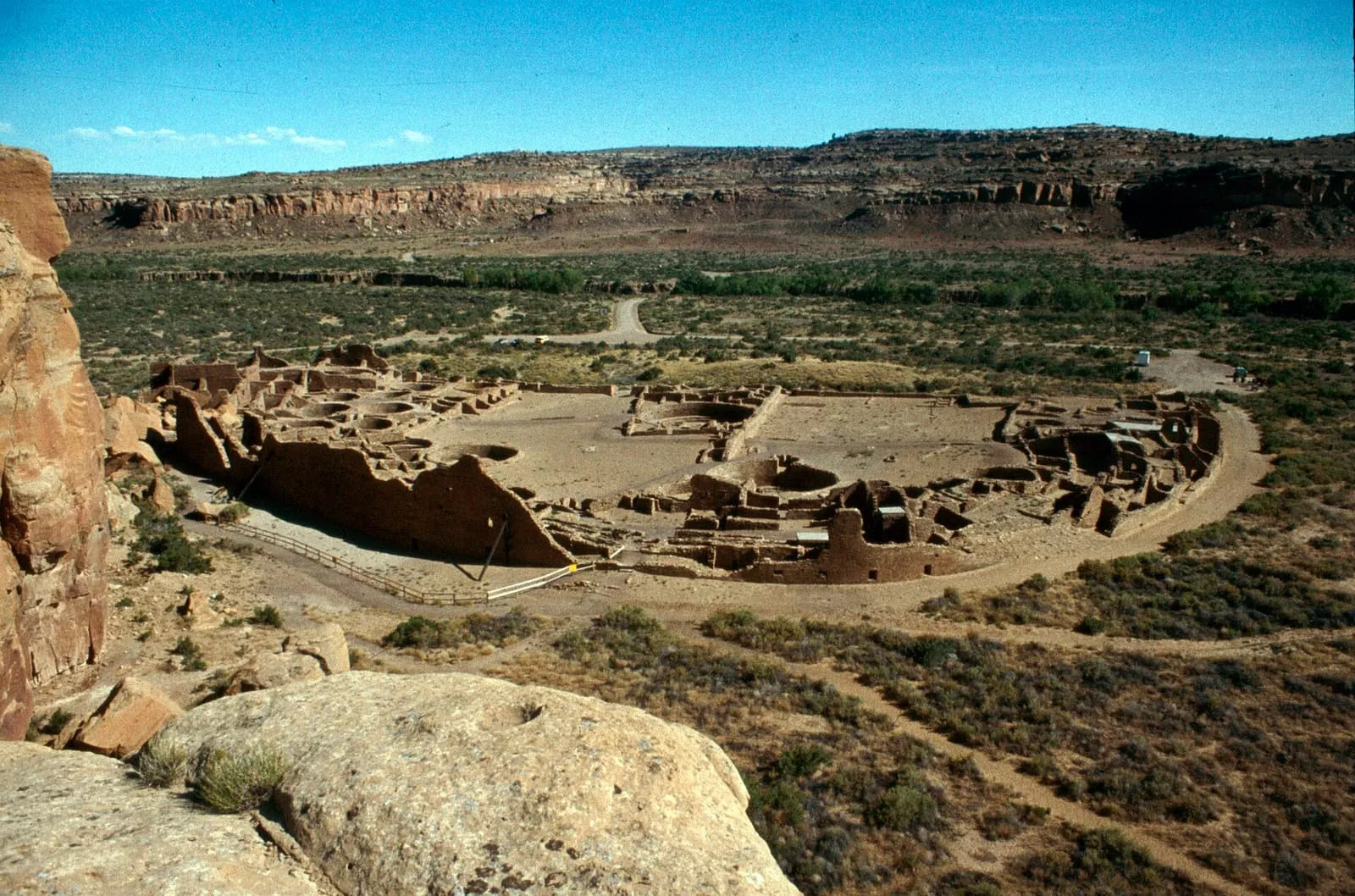
Using masonry techniques that were unique for their day, they built huge multi-storey stone buildings with hundreds of rooms, known as Great Houses. The buildings were planned from the outset, whereas adding rooms as needed had been the usual practice. Building work on some of them stretched over decades, even centuries.
How were the great houses built?
Pueblo Bonito, Una Vida and Peñasco Blanco were all built in the mid and late 800s. The buildings were often laid out to line up with the Sun, the Moon and the cardinal directions. Sightlines running between the great houses allowed people to communicate. Around the buildings stood advanced astronomical markers, means of communication, water-control devices and formal earthen mounds.
In the great houses, rooms became three or four times bigger, ceilings were twice as high, and a second, third and fourth storey were added. A thick rubble core with a finely worked stone facing gave the buildings both strength and beauty.
What were the great houses for?
By 1050, Chaco had grown into the ceremonial, administrative and economic hub of the San Juan Basin. Roads linked dozens of great houses within the canyon with more than 150 others across the region.
The great houses are not thought to have been traditional farming villages housing large populations. Rather, they may have been showpieces of “public architecture”, put to use when temporary crowds gathered for ceremonies, commerce and trade.
How far did the influence spread?
Chaco’s influence spread across the whole San Juan Basin and a little beyond. The outlying great houses in the region share most of the features of those in the canyon: core-and-veneer masonry and large-scale planning.
Chaco is still a puzzle
Pueblo descendants describe Chaco as a special gathering place, where many peoples and clans met to share ceremonies, traditions and knowledge. Chaco is also a lasting puzzle for researchers. We may never fully understand it.
In the 1100s and 1200s, new building slowed and Chaco’s role as a regional centre changed. Its influence lived on at Aztec, Mesa Verde, the Chuska Mountains and other centres to the north, south and west. The descendants of the Chacoans are today’s Native peoples of the Southwest.
Test yourself
Three questions from the article. Pick an answer to find out.
Question 1 of 3
How long did the cultural flowering of the Chacoan people last?
The Chacoans' cultural golden age started around the mid-800s and ran for over 300 years. Source: www.nps.gov
Show answer
Right answer: More than 300 years
The Chacoans' cultural golden age started around the mid-800s and ran for over 300 years. Source: www.nps.gov
Question 2 of 3
Which view of the great houses is correct?
The great houses are not thought to have been traditional farming villages housing large populations. Source: www.nps.gov
Show answer
Right answer: They are not thought to have been traditional farming villages housing large populations
The great houses are not thought to have been traditional farming villages housing large populations. Source: www.nps.gov
Question 3 of 3
What did the sightlines between the great houses allow?
Sightlines running between the great houses allowed people to communicate. Source: www.nps.gov
Show answer
Right answer: Communication
Sightlines running between the great houses allowed people to communicate. Source: www.nps.gov