How was the first transcontinental railroad completed?
How was the line completed?
The transcontinental railroad was finished on 10 May 1869. The Last Spike ceremony of 10 May 1869 took place at Promontory Summit. In 1869, some journalists and railroad officials reported that the line had been completed at Promontory Point; the correct name is Promontory Summit; Promontory Point lies thirty-five miles south of Golden Spike.
Preparing the way
Congress set aside money for the Army to survey five possible railroad routes between 1853 and 1855. The 1862 Railroad Act allowed the Central Pacific to build the western section and the Union Pacific the eastern one.
Progress was slow at first, as labour shortages were made worse by strikes and by a reluctance to raise wages. So the Central Pacific filled its vacant positions with Chinese immigrants. By 1868, about 11,000 Chinese workers were employed on building the Pacific Railroad.
Chinese workers
This technical feat would not have been possible without the labour of more than 12,000 Chinese immigrant workers. Chinese workers did a range of jobs, from grading crews to track layers, and from masons to cooks. Chinese workers were paid on average 30 percent less than their European or European American counterparts. They were organised into groups of up to 30 people, each with a leader responsible for collecting and distributing the wages.
Harsh working conditions
Working conditions were dangerous: freezing and sweltering temperatures, blizzards, avalanches, bad water and blasting accidents. These hazards killed an unknown number of workers; the total probably reached hundreds, or even thousands.
On 28 April 1869, in just 12 hours of work, crews laid 10 miles and 56 feet of track. That record has never been beaten. On 10 May, eight Chinese men put the final rail in place before noon. Chinese faces are absent from the photographs showing the crowd’s celebrations.
Promontory’s later story
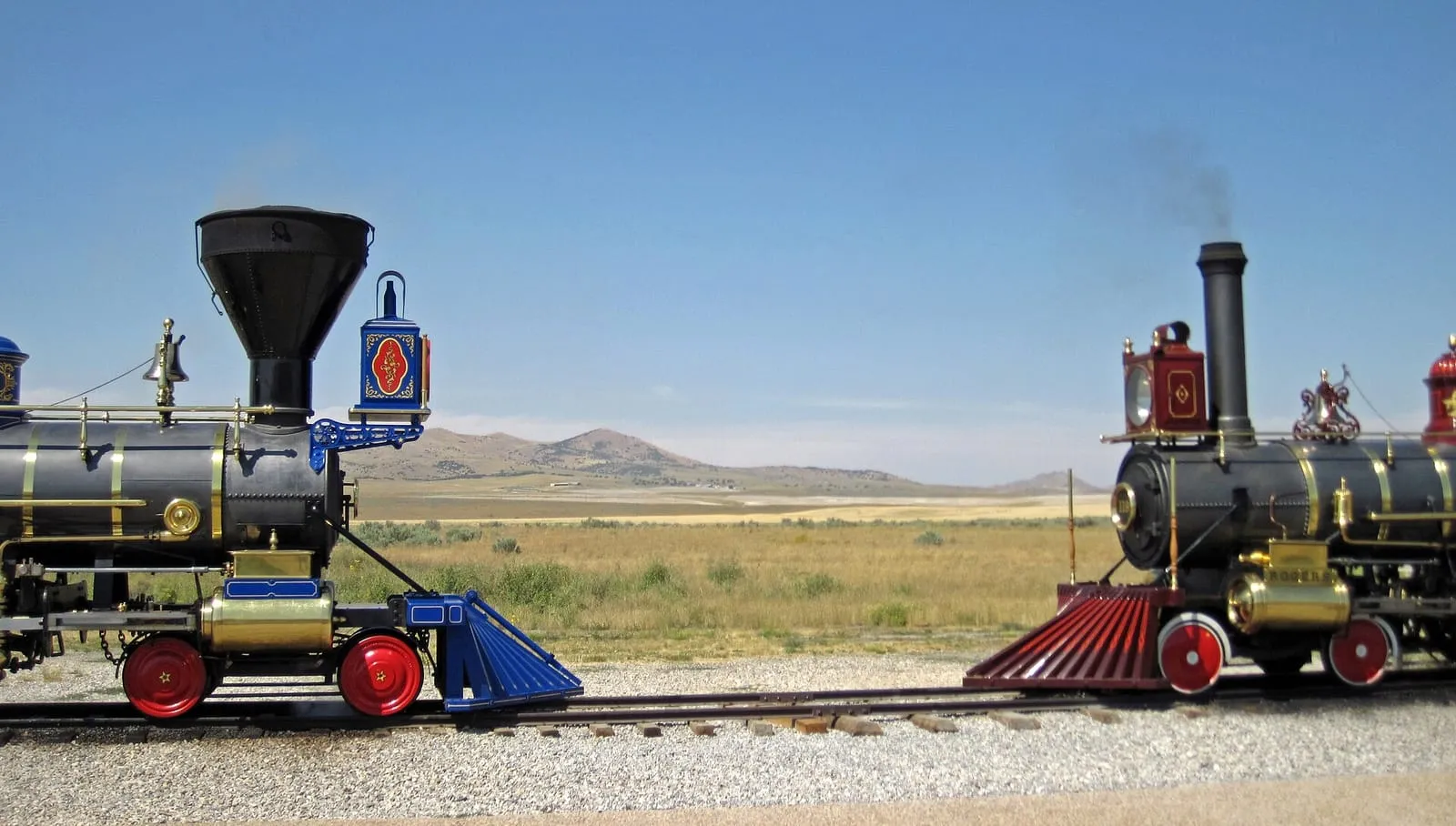
From May to December 1869, Promontory was the end of the line, where the Central Pacific and Union Pacific railroads met. Travellers and cargo changed trains here. When the meeting point moved to Ogden in 1870, Promontory became mainly an auxiliary station.
The exact number of people at the ceremony is unknown; sources estimate between 300 and 1,500. The real Golden Spike is in Palo Alto, California, in the collection of Stanford University’s Cantor Arts Center. The site hosts replicas of the locomotives Jupiter and No. 119; the originals were scrapped in the early 20th century.
Protecting the site
To protect the site, the US government established Golden Spike National Historical Park on 30 July 1965, under the protection of the National Park Service. This recognition came only after a 38-year, unceasing campaign by Bernice Gibbs Anderson to secure the place the site deserved.
Test yourself
Three questions from the article. Pick an answer to find out.
Question 1 of 3
Where did the Last Spike ceremony take place?
The Last Spike ceremony of 10 May 1869 took place at Promontory Summit. Source: www.nps.gov
Show answer
Right answer: Promontory Summit
The Last Spike ceremony of 10 May 1869 took place at Promontory Summit. Source: www.nps.gov
Question 2 of 3
How were Chinese workers paid compared with their European counterparts?
Chinese workers were paid on average 30 percent less than their European or European American counterparts. Source: home.nps.gov
Show answer
Right answer: On average 30 percent less
Chinese workers were paid on average 30 percent less than their European or European American counterparts. Source: home.nps.gov
Question 3 of 3
Where is the real Golden Spike today?
The real Golden Spike is in Palo Alto, California, in the collection of Stanford University's Cantor Arts Center. Source: www.nps.gov
Show answer
Right answer: In Palo Alto, California, in Stanford University's collection
The real Golden Spike is in Palo Alto, California, in the collection of Stanford University's Cantor Arts Center. Source: www.nps.gov