What is a supernova and how does it happen?
What is a supernova?
The photograph taken in 1987 during the SN 1987A supernova explosion can be compared with a photograph of the same patch of sky taken before the explosion.
Type Ia supernovae
Type Ia supernovae happen in some binary star systems, where a carbon-oxygen white dwarf gathers material from a companion star. One typical way this happens is for the white dwarf to pile on so much mass that its core reaches a critical density. This sets off runaway fusion of carbon and oxygen, and the star blows apart.
The energy of a Type Ia supernova comes from carbon and oxygen fusing out of control inside the white dwarf’s core.
Type II supernovae
Type II supernovae happen at the end of a massive star’s life, when its nuclear fuel is spent and it is no longer held up by the release of nuclear energy. A star whose iron core is massive enough will collapse and become a supernova. The core falls inward once it has gained more mass than it can bear under its own weight.
Neutrons can usually halt this collapse; nothing else in nature is known to be able to stop a gravitational collapse like this. When neutrons bring the collapse to a sudden stop, material bounces off the rigid iron core and turns the inward fall into an explosion.
The spectra of Type Ia supernovae show no hydrogen lines, while those of Type II supernovae do.
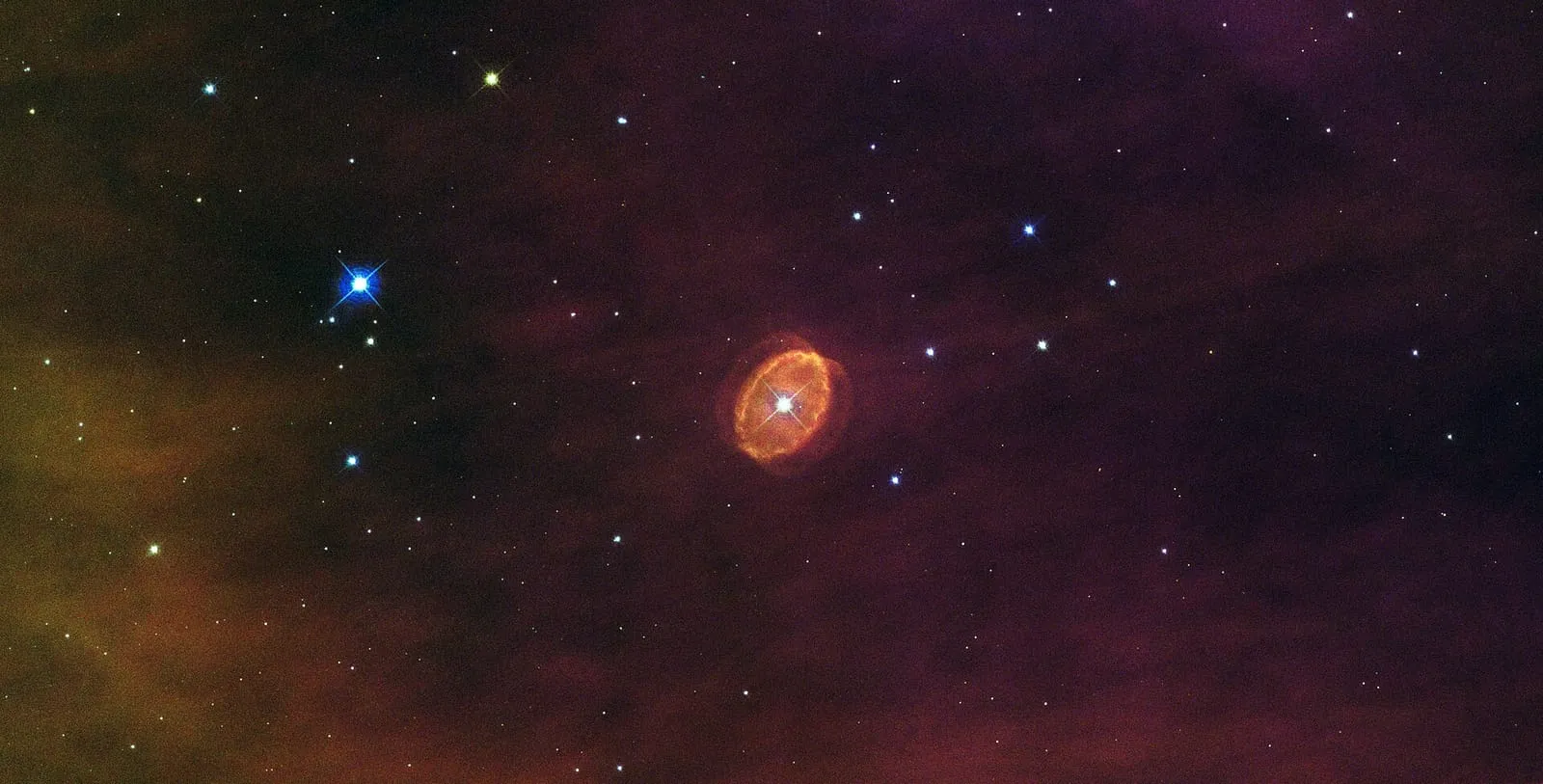
What happens to the core?
If the core has less than about 5 times the mass of the Sun, neutrons stop the collapse successfully and a neutron star forms. Sometimes we see neutron stars as pulsars or as X-ray binary systems.
Pulsars are a kind of rapidly spinning neutron star. Some spin faster than the blades of a blender.
If the core is more massive, nothing in the known universe can stop the collapse. In that case the core falls completely in on itself and a black hole forms.
After the explosion
When the star’s core collapses, an enormous shock wave is created. The shock wave drives the star’s atmosphere out into interstellar space and pushes out the elements made in the blast, and the star becomes a supernova remnant.
Nuclear fusion reactions that make elements heavier than iron need more energy than they give out, so they do not happen in typical stars under stable conditions. Supernovae are not stable, so they can make these heavier elements beyond iron. Supernovae also scatter the elements made by both the star and the supernova into interstellar space.
How often do supernovae happen?
Within our own galaxy, supernovae are comparatively uncommon, occurring roughly once every hundred years. The most recent one nearby took place in 1680, and the two before 1680 were observed by Tycho Brahe in 1572 and by Johannes Kepler in 1604. In 1987 a supernova exploded in the Large Magellanic Cloud, a companion galaxy of the Milky Way.
Test yourself
Three questions from the article. Pick an answer to find out.
Question 1 of 3
What powers a supernova?
Gravity provides the energy for a supernova. Source: NASA
Question 2 of 3
What forms if neutrons halt the collapse of a star whose core has less than about 5 solar masses?
If the core has less than about 5 solar masses, neutrons stop the collapse and a neutron star forms. Source: NASA
Show answer
Right answer: A neutron star
If the core has less than about 5 solar masses, neutrons stop the collapse and a neutron star forms. Source: NASA
Question 3 of 3
When does a massive star go supernova?
This kind of supernova occurs when a massive star has run out of nuclear fuel at the end of its life. Source: NASA
Show answer
Right answer: At the end of its life, when its nuclear fuel is spent
This kind of supernova occurs when a massive star has run out of nuclear fuel at the end of its life. Source: NASA