What are the layers of Earth's atmosphere?
Why does the atmosphere matter?
The atmosphere supplies the air we breathe and shields us from harmful ultraviolet rays. It also traps heat, which keeps temperatures mild enough to live in. Without it, Earth would be more like the Moon, with extreme swings in temperature between night and day.
The layers are told apart by things like temperature, chemical makeup and air density.
Troposphere
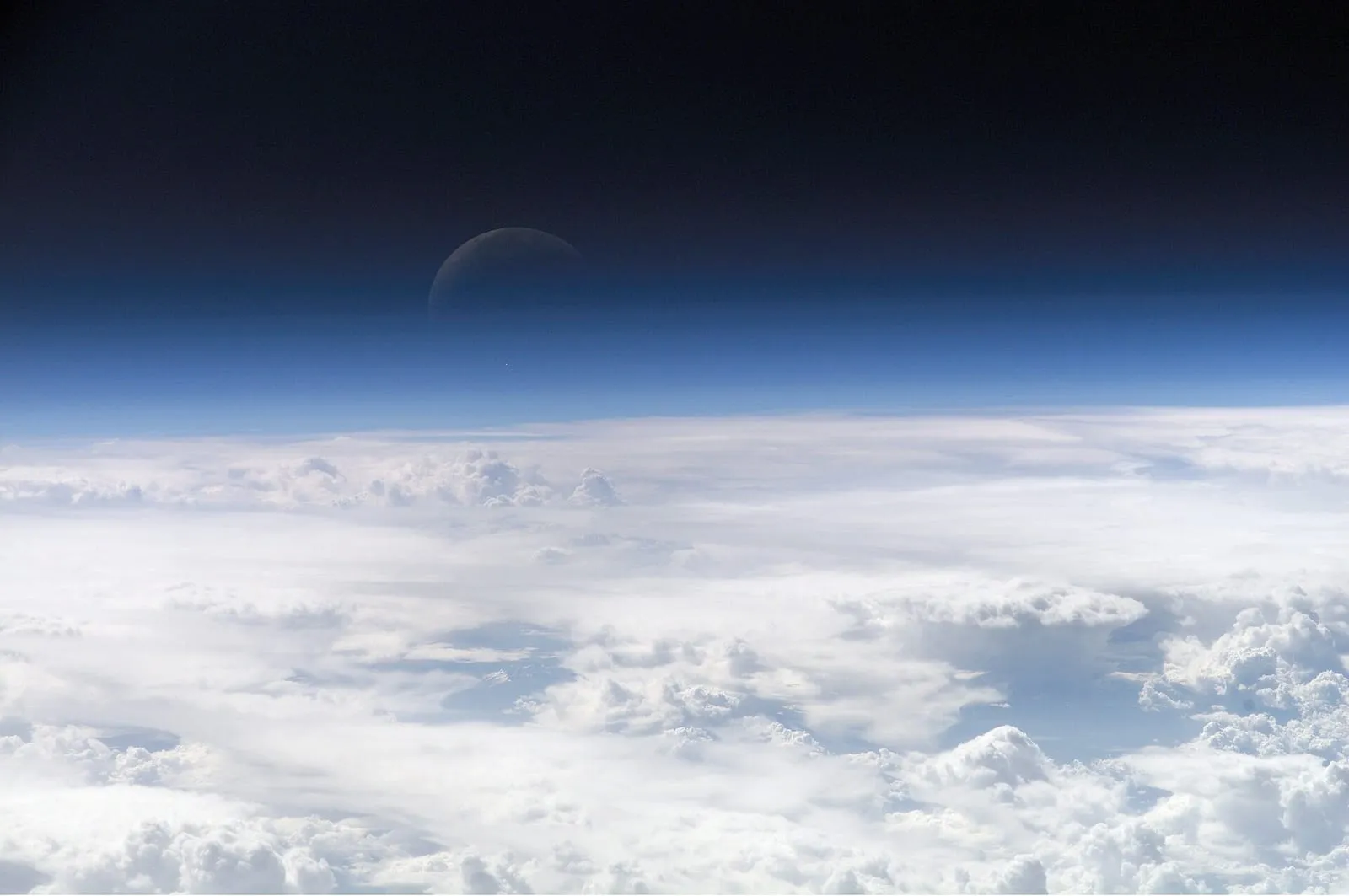
The troposphere reaches an average of about 12 kilometres above the ground, lower at the poles and higher at the equator. This thin layer holds all the air that plants need for photosynthesis and animals need to breathe. It also contains about 99 percent of the water vapour and aerosols in the atmosphere.
In the troposphere, temperature usually drops as you go higher. That is why we see snow on mountain tops: the air thins and cools with height. The troposphere is the densest layer of the atmosphere because the layers above press down on it.
Almost all the clouds that come with weather are found here. The one exception is cumulonimbus storm clouds, whose tops can rise into the lowest part of the stratosphere above.
Stratosphere
The stratosphere lies roughly 12 to 50 kilometres above the ground. It is best known as the home of the ozone layer, which protects us from the Sun’s harmful ultraviolet radiation. Because of that radiation, temperature rises with height in the stratosphere.
The stratosphere is almost cloudless and free of weather, apart from occasional polar stratospheric clouds in its lowest, coldest parts. With less convection, the air in the lower stratosphere is calmer than in the troposphere. Passenger aircraft fly in this region.
Mesosphere
The mesosphere sits roughly 50 to 80 kilometres above the ground, and it gets colder as you rise. Its top is the coldest place in the Earth system, where it averages around minus 85 degrees Celsius.
Noctilucent clouds, the highest clouds you can see with the naked eye, form from the little water vapour found near the top of the mesosphere. Most meteors burn up in this layer.
Thermosphere and ionosphere
The thermosphere lies roughly 80 to 700 kilometres above the ground, and its lower part contains the ionosphere. The molecules here are very sparse, so temperature rises with height. It can reach 2000 degrees Celsius or even more.
This layer has no clouds and no water vapour. The thermosphere is where the International Space Station circles Earth. Parts of the mesosphere and thermosphere hold regions of high-energy electrons and ionised atoms, known as the ionosphere. The northern and southern lights sometimes appear in the thermosphere.
Exosphere
The exosphere is the outermost layer of the atmosphere, roughly 700 to 10,000 kilometres above the ground. The molecules here are so sparse that the layer does not behave like a gas, and particles escape into space. Most of Earth’s satellites orbit in the exosphere.
Where does the atmosphere end?
There is no clear line where Earth’s atmosphere ends and space begins. Most scientists mark the transition at the Karman line, 100 kilometres above the ground. Below that height sits 99.99997 percent of the atmosphere.
According to a 2019 study, the geocorona, a cloud of hydrogen atoms at the far edge of the atmosphere, may stretch far beyond the Moon’s orbit, to about 629,300 kilometres.
Test yourself
Three questions from the article. Pick an answer to find out.
Question 1 of 3
Which layer of the atmosphere is home to most weather?
Most weather happens in the troposphere, the lowest layer of the atmosphere. Source: NASA
Show answer
Right answer: Troposphere
Most weather happens in the troposphere, the lowest layer of the atmosphere. Source: NASA
Question 2 of 3
The coldest place in the Earth system is at the top of which atmospheric layer?
The top of the mesosphere is the coldest place in the Earth system. Source: NASA
Show answer
Right answer: Mesosphere
The top of the mesosphere is the coldest place in the Earth system. Source: NASA
Question 3 of 3
How far above the ground do most scientists place the boundary between the atmosphere and space?
Most scientists use the Karman line, 100 kilometres above the ground, as the transition point. Source: NASA
Show answer
Right answer: 100 kilometres
Most scientists use the Karman line, 100 kilometres above the ground, as the transition point. Source: NASA