How does a solar eclipse happen?
What is a solar eclipse?
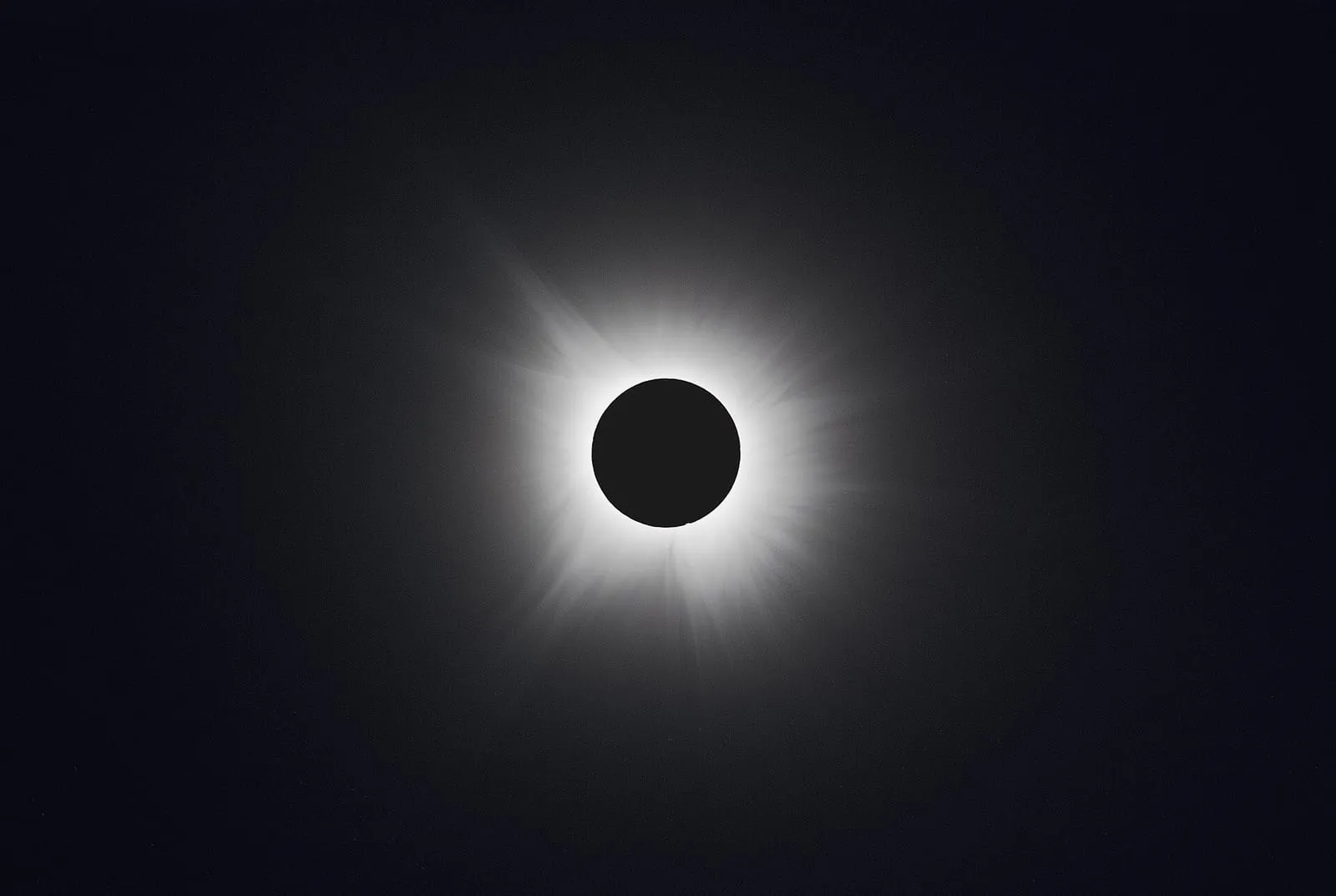
Solar eclipses happen at new moon, while lunar eclipses happen at full moon. In a total solar eclipse, the Moon passes between the Earth and the Sun and completely blocks the Sun’s light.
How does the Moon cover the Sun?
The Moon is about 400 times smaller than the Sun, but it is also about 400 times closer to the Earth. As a result, seen from the Earth, the Moon and the Sun look roughly the same size in the sky.
Kinds of solar eclipse
There are four kinds of solar eclipse: total, partial, hybrid and annular. The kind of eclipse we see depends on how the Moon lines up with the Earth and the Sun and on how far the Moon is from the Earth.
In a partial eclipse, the Moon’s partial shadow (the penumbra) sweeps across the Earth. In an annular eclipse, the Moon is too far from the Earth to cover the Sun completely. In a total eclipse, the Moon is close enough to the Earth to cover the Sun completely. A hybrid eclipse looks annular in some parts of its path and total in others.
The Moon’s orbit is not perfectly round, so the Moon is sometimes a little farther from the Earth than at other times. Sometimes the Moon is so far away that no total eclipse occurs. The Moon then hides most of the Sun, yet a slim ring of sunlight stays visible around its edge.
How long do they last and how often?
The longest a total solar eclipse can last is 7.5 minutes. An eclipse goes unnoticed until the Moon covers more than 90 percent of the Sun; at 99 percent coverage, daylight resembles local twilight.
Total solar eclipses happen somewhere on Earth about once every year or two. Somewhere on Earth, there are at least 2 solar eclipses a year. There can be at most 5 solar eclipses in a year.
Why not every month?
Eclipse season is one of only two periods a year when the Sun, Moon and Earth line up so that eclipses can occur. Each eclipse season lasts about 35 days and starts again a little less than six months later.
The corona and eye safety
The corona is the Sun’s outer atmosphere; we normally cannot see it because the surface beneath is far brighter, but it appears during a total solar eclipse.
Except during the brief totality of a total eclipse, you should not look at the Sun without proper eye protection. Eclipse glasses are not the same as ordinary sunglasses; ordinary sunglasses are not safe for looking at the Sun.
What have eclipses taught science?
For more than a century, solar eclipses have helped scientists work out the structure of the Sun and its explosive events, find evidence for the theory of general relativity and discover a new element. Eclipse records kept by scribes in the Chinese city of Anyang helped determine how the Earth’s rotation has changed over time.
This will not last forever
The Moon’s orbit grows by about 3.8 centimetres each year. Total solar eclipses will vanish altogether only after more than 600 million years.
Test yourself
Three questions from the article. Pick an answer to find out.
Question 1 of 3
How many kinds of solar eclipse are there?
There are four kinds of solar eclipse: total, partial, hybrid and annular. Source: NASA
Show answer
Right answer: Four: total, partial, hybrid and annular
There are four kinds of solar eclipse: total, partial, hybrid and annular. Source: NASA
Question 2 of 3
At which phase of the Moon do solar eclipses occur?
Solar eclipses happen at new moon, while lunar eclipses happen at full moon. Source: NASA
Show answer
Right answer: New moon
Solar eclipses happen at new moon, while lunar eclipses happen at full moon. Source: NASA
Question 3 of 3
About how many times smaller than the Sun is the Moon?
The Moon is about 400 times smaller than the Sun, but it is also about 400 times closer to the Earth. Source: NASA Space Place
Show answer
Right answer: About 400 times
The Moon is about 400 times smaller than the Sun, but it is also about 400 times closer to the Earth. Source: NASA Space Place