Why do eye colours differ?
The iris and eye colour
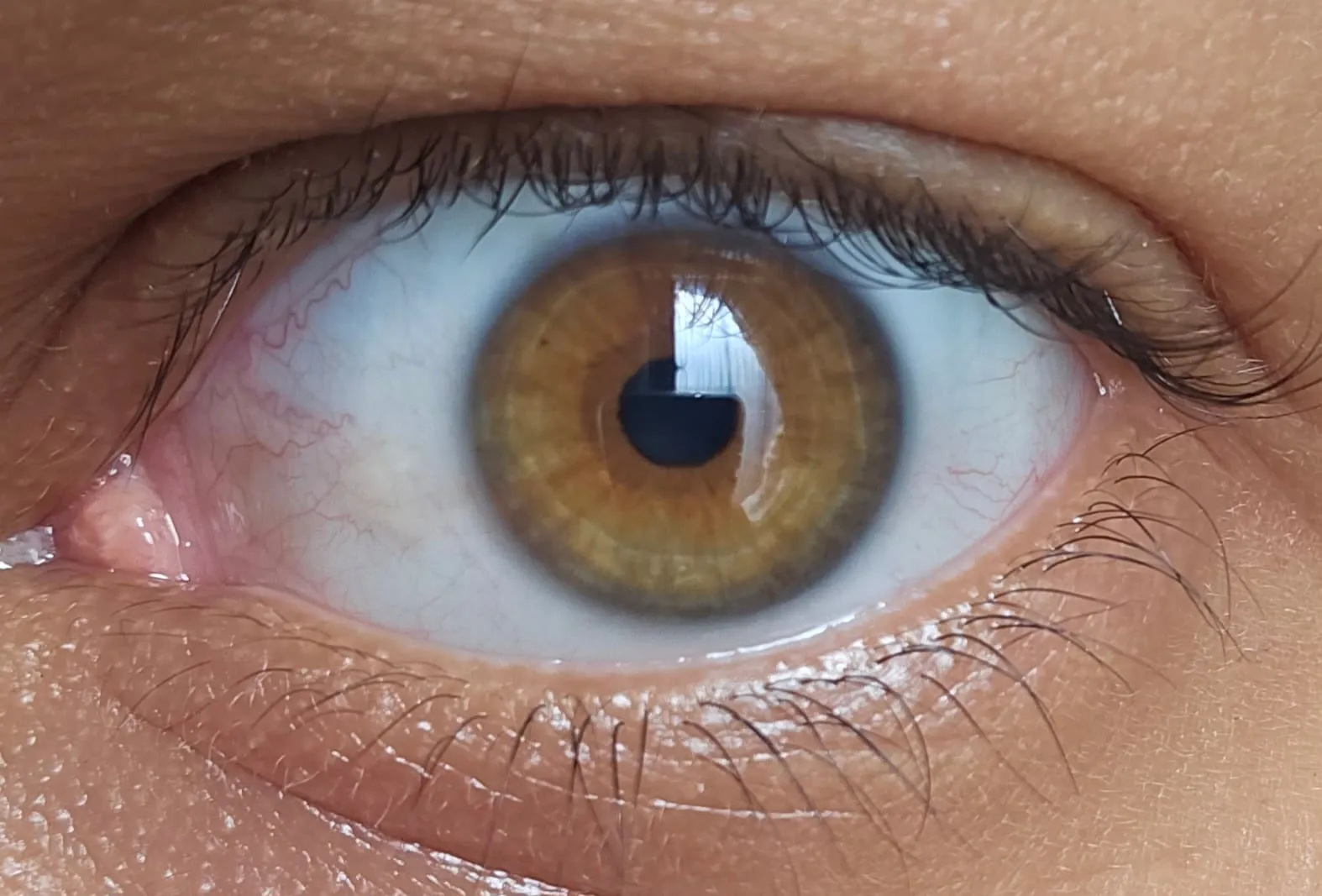
Eye colour comes from the pigmentation of the iris, the structure that surrounds the pupil. The iris also helps control how much light enters the eye.
The colour of the iris forms a continuum from very pale blue to dark brown. Eye colour is usually classed as blue, green/hazel or brown. Worldwide, the most common eye colour is brown.
Melanin and genes
Eye colour is determined by differences in a person’s genes. Most of the genes linked to eye colour play a part in producing, transporting or storing a pigment called melanin. How much melanin sits in the front layers of the iris is what shapes eye colour. The iris of brown-eyed people contains a lot of melanin; blue-eyed people have far less of this pigment.
A particular region of chromosome 15 plays a major role in eye colour. Two genes lie very close together in this region: OCA2 and HERC2. The P protein made by the OCA2 gene takes part in the maturation of melanosomes, the cell structures that make and store melanin. A few common variations in the OCA2 gene reduce the amount of functional P protein; less P protein means less melanin in the iris. In people who carry a variation in this gene, this means blue eyes instead of brown.
A region called intron 86 of the nearby HERC2 gene contains a piece of DNA that controls the activity of the OCA2 gene. Studies have found that at least one variation in this stretch of HERC2 lowers how strongly OCA2 is expressed and how much P protein is made, so the iris holds less melanin and the eyes are lighter.
A handful of other genes have smaller parts in setting eye colour. Some of these genes also play a part in skin and hair colour. Most likely, these genes add their effects to those of OCA2 and HERC2, which gives people a whole range of eye colours.
Inheritance is more complex than we thought
Researchers used to think that a single gene determined eye colour and that brown eyes were dominant over blue in a simple pattern of inheritance. Later studies showed that this model was too simple. Although it is rare, blue-eyed parents can have brown-eyed children. Because more than one gene is involved, the inheritance of eye colour is more complex than first thought. A child’s eye colour can often be predicted from the eye colour of the parents and other relatives, but genetic variations sometimes produce unexpected results.
Two eyes of different colours
In a condition called heterochromia, the two eyes of the same person are different colours. Heterochromia can result from genetic changes or from a problem during the development of the eye; it can also be acquired later as a result of disease or injury.
Test yourself
Three questions from the article. Pick an answer to find out.
Question 1 of 3
Which is the most common eye colour worldwide?
Worldwide, the most common eye colour is brown. Source: MedlinePlus Genetics
Show answer
Right answer: Brown is the most common eye colour
Worldwide, the most common eye colour is brown. Source: MedlinePlus Genetics
Question 2 of 3
Is it possible for a child of two blue-eyed parents to have brown eyes?
Although it is rare, blue-eyed parents can have brown-eyed children. Source: MedlinePlus Genetics
Show answer
Right answer: Yes, although it is rare
Although it is rare, blue-eyed parents can have brown-eyed children. Source: MedlinePlus Genetics
Question 3 of 3
When common variations in the OCA2 gene reduce the amount of P protein, what happens in the iris?
A few common variations in the OCA2 gene reduce the amount of functional P protein; less P protein means less melanin in the iris. Source: MedlinePlus Genetics
Show answer
Right answer: There is less melanin
A few common variations in the OCA2 gene reduce the amount of functional P protein; less P protein means less melanin in the iris. Source: MedlinePlus Genetics